Predicting the stages of dementia using the OASIS dataset
Objective
The primary objective of this study is to explore the potential of the OASIS dataset for predicting the stages of dementia using machine learning techniques.
Abstract
Dementia is a progressive neurodegenerative condition that impacts cognitive functions, memory, and behaviour. Early detection and accurate prediction of the stages of dementia are essential for improving patient care and providing timely interventions. In this study, we explore the use of the OASIS (Open Access Series of Imaging Studies) dataset to predict the stages of dementia, ranging from normal cognitive function to advanced Alzheimer’s disease. The OASIS dataset includes neuroimaging data, demographic information, and clinical assessments from a diverse set of participants, providing a rich resource for machine learning-based predictive modelling. We applied a range of machine learning algorithms, including support vector machines (SVM), random forests, and deep learning techniques, to analyse the dataset and predict the progression of dementia. Feature selection methods were used to identify the most significant predictors, such as age, gender, brain volume, and cognitive test scores. The dataset was divided into training and testing subsets to evaluate the performance of the models, with accuracy, precision, recall, and F1-score used as evaluation metrics. Our findings indicate that the machine learning models can effectively classify individuals into different stages of dementia with a high degree of accuracy. The random forest algorithm outperformed other models in terms of classification accuracy and robustness, while deep learning models showed potential for capturing more complex patterns in the data. By leveraging neuroimaging features alongside clinical data, the model provides a comprehensive tool for predicting the trajectory of dementia progression, ultimately contributing to better personalized care strategies. This study demonstrates the feasibility of using the OASIS dataset for dementia prediction and highlights the potential of machine learning in enhancing early diagnosis and staging of dementia-related conditions.
Keywords: Dementia, OASIS dataset, machine learning, Alzheimer’s disease, predictive modelling, neuroimaging, classification, early diagnosis, brain volume, cognitive testing.
NOTE: Without the concern of our team, please don't submit to the college. This Abstract varies based on student requirements.
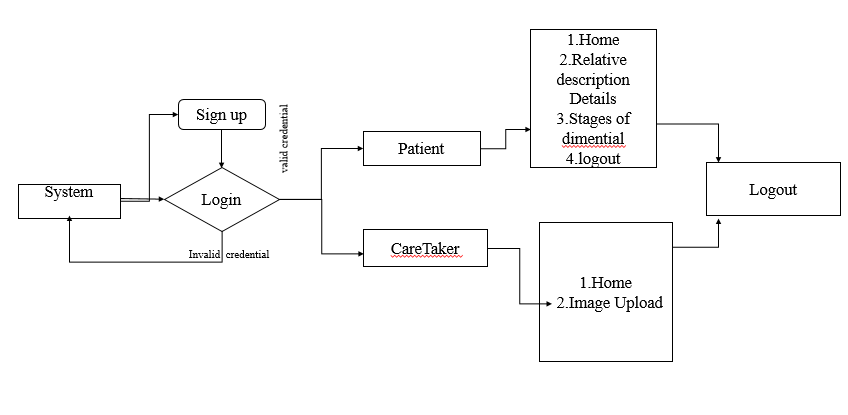
Block Diagram
Specifications
H/W SPECIFICATIONS:
· Processor : I5/Intel Processor
· RAM : 8GB (min)
· Hard Disk : 128 GB
· Key Board : Standard Windows Keyboard
· Mouse : Two or Three Button Mouse
· Monitor : Any
S/W SPECIFICATIONS:
• Operating System : Windows 7+
• Server-side Script : Python 3.6+
• IDE : PyCharm / VSCode
• Libraries Used : Pandas, Numpy, Matplotlib, OS.

Demo Video


Request for Video
 Paper Publishing
Request Call Back
Would you like to receive a free callback now?
Choose the best time for callback:
Leave your message and we will contact you as soon as possible

6-2-85/B, Old Maternity Hospital Road, Thyagaraja Nagar, Tirupati, Andhra Pradesh – 517501
+91 9030333433
+91 9393939065
0877-2261612

Disclaimer - Takeoff Edu Group Projects are not associated or affiliated with IEEE in any way. The IEEE Projects mentioned here are mentioned in the context of student projects, whose ideas are derived from IEEE publications, not projects of or by IEEE.

