Predicting Ship Main Engine Fuel Oil Consumption Using Hybrid Temporal-Spatial Attention Network
Objective
The main objective of this project is to develop an accurate and efficient prediction system for estimating ship main engine fuel oil consumption using advanced deep learning models. The project aims to analyze ship operational, fuel, and emission-related parameters to identify meaningful patterns that influence fuel usage. By applying Hybrid Temporal-Spatial Attention Network, Graph Neural Network, and Transformer-based Regression Model, the system focuses on improving prediction accuracy compared with conventional machine learning methods. It also supports fuel optimization, cost reduction, and emission control in maritime operations, helping shipping industries make better data-driven decisions for sustainable and efficient vessel management
Abstract
Predicting ship main engine fuel oil consumption is an important task for improving fuel efficiency, reducing operational cost, and minimizing harmful emissions in maritime transportation. Conventional shallow machine learning models often fail to capture complex operational patterns, while deep neural networks with fully connected layers may increase computational complexity and reduce practical deployment efficiency. To address these limitations, this project proposes a Hybrid Temporal-Spatial Attention Network (HTSAN) for accurate prediction of ship main engine fuel oil consumption. The proposed system uses historical ship operational and emission-related data from the Kaggle ship fuel consumption and CO₂ emissions dataset. HTSAN captures temporal dependencies from sequential operating conditions and spatial relationships among engine, fuel, and environmental parameters using attention mechanisms. In addition, a Graph Neural Network (GNN) with Engine-Environment Graph is used to represent the relationship between ship engine behaviour and external environmental factors, while a Transformer-based Regression Model is applied to learn long-range dependencies in the data. The experimental results show that the proposed HTSAN model achieves a high R² score of 0.99, outperforming the Transformer-based Regression Model, which achieves an R² score of 0.93. The results indicate that the hybrid attention-based approach provides better prediction accuracy, model robustness, and decision support for energy-efficient ship operation.
Keywords: Ship fuel consumption, Main engine, HTSAN, Graph Neural Network, Transformer regression, Fuel efficiency, CO₂ emissions, Maritime transportation.
NOTE: Without the concern of our team, please don't submit to the college. This Abstract varies based on student requirements.
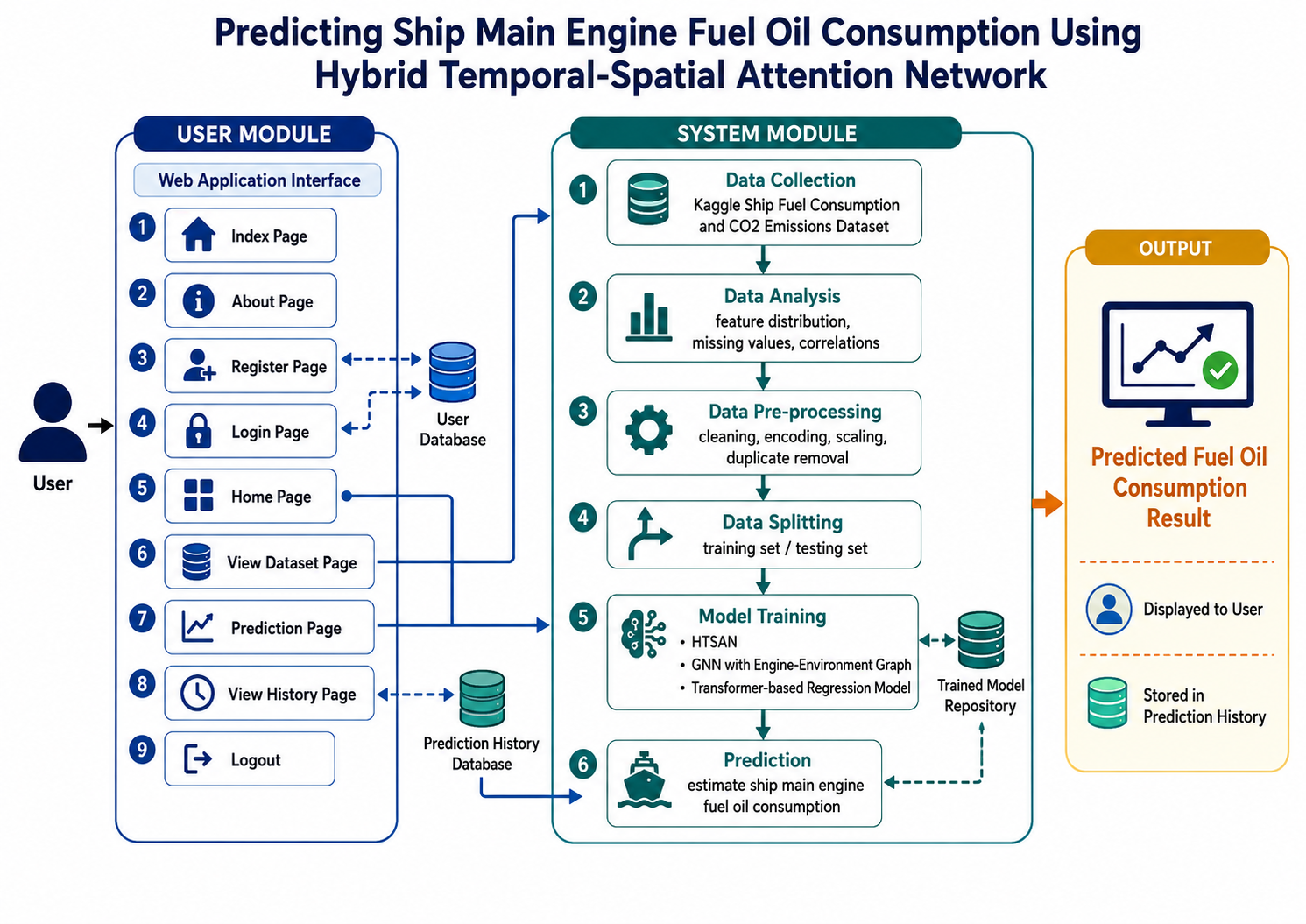
Block Diagram
Specifications
Hardware Requirements
Processor - I3/Intel Processor
Hard Disk - 160GB
Key Board - Standard Windows Keyboard
Mouse - Two or Three Button Mouse
Monitor - SVGA
RAM - 8GB
Software Requirements:
Operating System : Windows 7/8/10
Server side Script : HTML, CSS, Bootstrap & JS
Programming Language : Python
Libraries : Django, Pandas, Numpy, Tensorflow, Scikit-learn.
IDE/Workbench : VS Code
Technology : Python 3.10
Database : SQLite

Demo Video


Request for Video
 Paper Publishing
Request Call Back
Would you like to receive a free callback now?
Choose the best time for callback:
Leave your message and we will contact you as soon as possible

6-2-85/B, Old Maternity Hospital Road, Thyagaraja Nagar, Tirupati, Andhra Pradesh – 517501
+91 9030333433
+91 9393939065
0877-2261612

Disclaimer - Takeoff Edu Group Projects are not associated or affiliated with IEEE in any way. The IEEE Projects mentioned here are mentioned in the context of student projects, whose ideas are derived from IEEE publications, not projects of or by IEEE.

