Predicting Diabetic Retinopathy and Nephropathy Complications Using Machine Learning Techniques
Objective
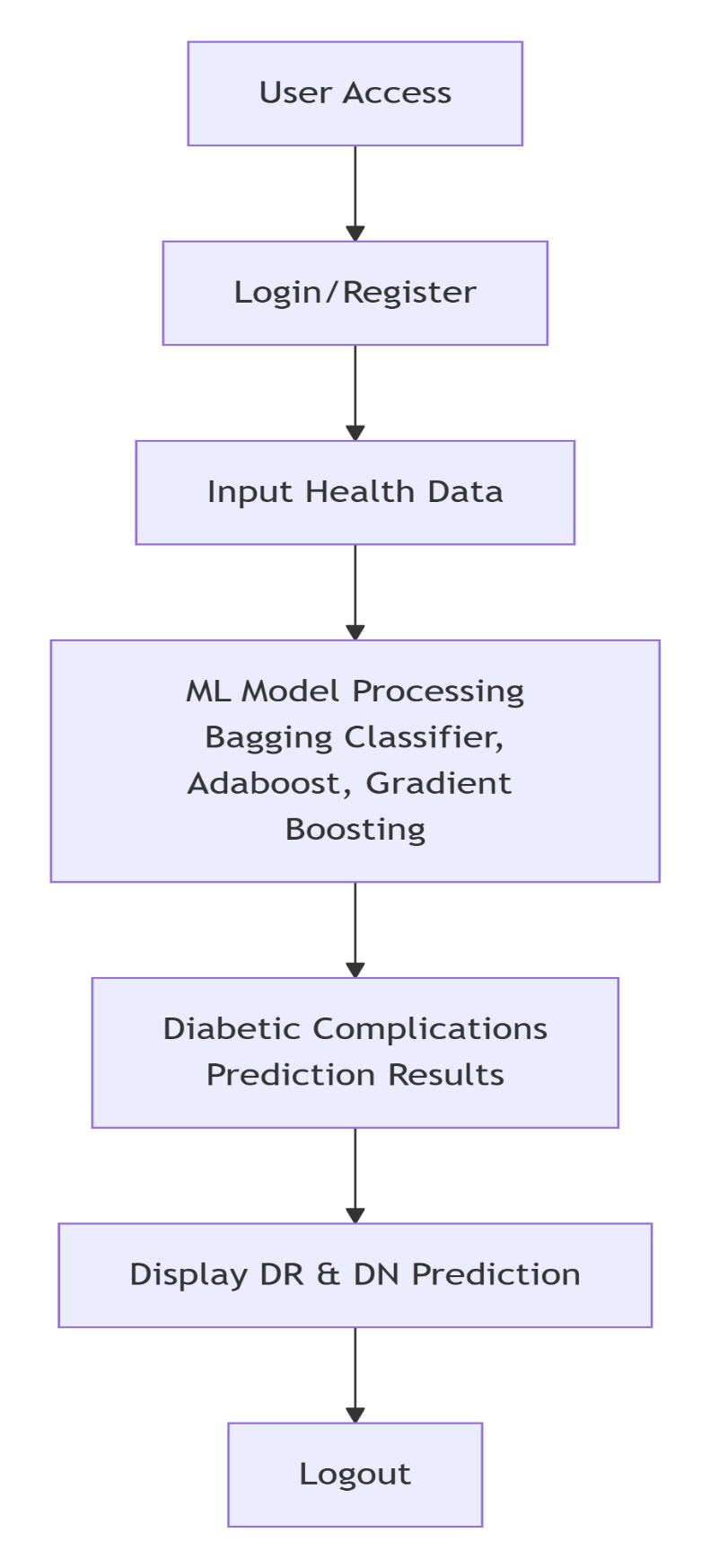
The objective of this project is to develop an effective machine learning-based system for predicting the likelihood of Diabetic Retinopathy and Diabetic Nephropathy complications. To achieve this, the project will first focus on collecting a comprehensive dataset containing health-related features such as age, diabetes duration, medication usage, and HbA1c levels. The next step will involve preprocessing the data by handling missing values, normalizing numerical features, and encoding categorical variables. Once the data is prepared, various machine learning algorithms, including Bagging Classifier, Adaboost, and Gradient Boosting, will be trained to predict the risk of these complications.
Abstract
Diabetic Retinopathy (DR) and Diabetic Nephropathy (DN) are serious complications associated with diabetes, leading to severe health outcomes such as blindness and kidney failure. Early prediction and intervention are crucial in preventing or delaying the progression of these complications. This project aims to predict the likelihood of DR and DN using machine learning techniques. The dataset used for this study includes key health parameters such as age, diabetes duration, HbA1c levels, insulin usage, smoking habits, and more. The machine learning models used for prediction include Bagging Classifier, Adaboost, and Gradient Boosting, which are trained to identify the risk of these complications based on the input data. The project is developed as a web-based application using the Flask framework, allowing users to enter their health data and receive predictions about their risk for DR and DN. The system includes essential features like user registration, login, and a classification module that performs the prediction. This project not only aims to provide an accessible tool for healthcare practitioners but also empowers individuals to monitor their health conditions. By automating the prediction process, this system can help identify high-risk individuals early on, allowing for timely intervention and better management of diabetes. The models’ performance will be evaluated based on accuracy, precision, recall, and F1-score to ensure reliable predictions. This approach integrates machine learning with a web interface to offer an efficient and user-friendly solution for predicting diabetic complications.
Keywords: Diabetic Retinopathy, Diabetic Nephropathy, Machine Learning, Bagging Classifier, Adaboost, Gradient Boosting, Diabetes, Prediction, Healthcare
NOTE: Without the concern of our team, please don't submit to the college. This Abstract varies based on student requirements.
Block Diagram
Specifications
HARDWARE REQUIREMENTS
• Processor - I5/Intel Processor
• RAM - 8GB (min)
• Hard Disk - 160 GB
• Key Board - Standard Windows Keyboard
• Mouse - Two or Three Button Mouse
• Monitor - Any
SOFTWARE REQUIREMENS
• Operating System : Windows 7/8/10
• Server side Script : HTML, CSS, Bootstrap & JS
• Programming Language : Python
• Libraries : Flask, Pandas, Mysql.connector, Os, Numpy,
Scikit-learn.
• IDE/Workbench : VS-Code
• Technology : Python 3.10+
• Server Deployment : Xampp Server
• Database : MySQL


 Paper Publishing

Request Call Back
Would you like to receive a free callback now?
Choose the best time for callback:
Leave your message and we will contact you as soon as possible

6-2-85/B, Old Maternity Hospital Road, Thyagaraja Nagar, Tirupati, Andhra Pradesh – 517501
+91 9030333433
+91 9393939065
0877-2261612

Disclaimer - Takeoff Edu Group Projects are not associated or affiliated with IEEE in any way. The IEEE Projects mentioned here are mentioned in the context of student projects, whose ideas are derived from IEEE publications, not projects of or by IEEE.

