Predicting Diabetic Distress and Emotional Burden in Type-2 Diabetes Using Explainable AI
Objective
The objective of this project is to develop a predictive model for identifying diabetic distress and emotional burden in individuals with Type-2 Diabetes Mellitus (T2DM) using machine learning techniques. By leveraging multimodal data, including patient demographics, laboratory results, and survey scores, the project aims to enhance the recognition of psychological challenges faced by T2DM patients. The study also incorporates Explainable Artificial Intelligence (XAI) to ensure that the predictions made by the models are transparent and interpretable, facilitating better understanding and decision-making for healthcare providers. Ultimately, the goal is to improve patient care through early detection and targeted interventions.
Abstract
Diabetic distress is a psychological condition commonly experienced by individuals with Type-2 Diabetes Mellitus (T2DM), significantly impacting their quality of life. Despite its high prevalence, diabetic distress is often underdiagnosed, which can lead to poor patient outcomes. This study aims to predict diabetic distress and emotional burden in T2DM patients by integrating multimodal data sources, including demographic information, laboratory results, and survey-based assessments. Various machine learning algorithms, such as CatBoost, LightGBM, Decision Tree, and Random Forest, were employed to train prediction models on this dataset. The integration of Explainable Artificial Intelligence (XAI) techniques ensures the transparency of predictions, allowing healthcare professionals to understand the reasoning behind model outputs. The findings of this study could enhance the recognition of diabetic distress and emotional burden in T2DM patients, offering valuable insights for clinical interventions aimed at improving patient well-being and disease management.
Keywords: Diabetic distress, emotional burden, Type-2 Diabetes Mellitus, machine learning, multimodal data, Explainable AI, CatBoost, LightGBM, Random Forest, Decision Tree, healthcare, patient well-being, emotional health.
NOTE: Without the concern of our team, please don't submit to the college. This Abstract varies based on student requirements.
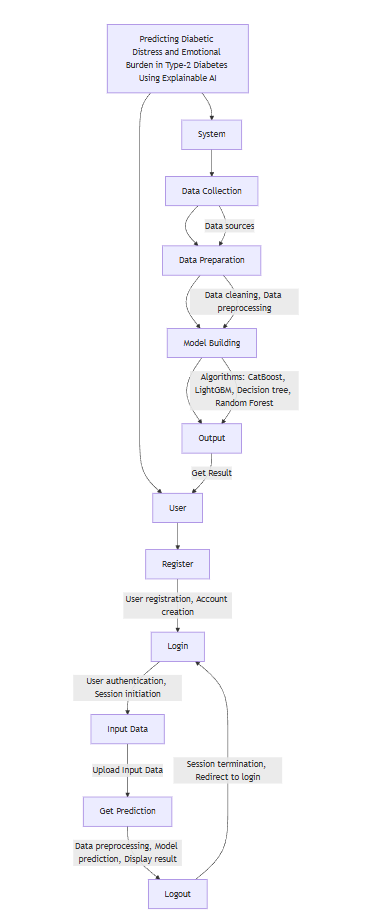
Block Diagram
Specifications
Hardware Requirements
Processor - I3/Intel Processor
Hard Disk - 160GB
Key Board - Standard Windows Keyboard
Mouse - Two or Three Button Mouse
Monitor - SVGA
RAM - 8GB
Software Requirements:
Operating System : Windows 7/8/10
Server side Script : HTML, CSS, Bootstrap & JS
Programming Language : Python
Libraries : Django, Pandas, Numpy, Tensorflow, Scikit-learn.
IDE/Workbench : VS Code
Technology : Python 3.10
Database : SQLite

Demo Video


Request for Video
 Paper Publishing
Request Call Back
Would you like to receive a free callback now?
Choose the best time for callback:
Leave your message and we will contact you as soon as possible

6-2-85/B, Old Maternity Hospital Road, Thyagaraja Nagar, Tirupati, Andhra Pradesh – 517501
+91 9030333433
+91 9393939065
0877-2261612

Disclaimer - Takeoff Edu Group Projects are not associated or affiliated with IEEE in any way. The IEEE Projects mentioned here are mentioned in the context of student projects, whose ideas are derived from IEEE publications, not projects of or by IEEE.

