Predicting Diabetic Distress and Emotional Burden in Type-2 Diabetes Using Explainable AI
Objective
The main objective of this project is to develop an explainable machine learning system capable of predicting diabetic distress levels in individuals with Type-2 Diabetes. This is achieved by utilizing both clinical and emotional features to classify distress into two categories: low or high. To accomplish this goal, the project first focuses on preprocessing and preparing the dataset to ensure high-quality inputs for effective model training. Following this, a range of existing machine learning algorithms including XGBoost, Random Forest, Support Vector Machine (SVM), Logistic Regression, Ridge Regression, Lasso Regression, and Multi-Layer Perceptron are implemented and compared for their performance in predicting distress levels. Additionally, the project explores the development of advanced ensemble models such as Stacking Classifier, Voting Classifier, TabNet, and CatBoost to further enhance prediction accuracy and model interpretability.
Abstract
This
project focuses on predicting diabetic distress and emotional burden in
individuals with Type-2 Diabetes using explainable artificial intelligence (AI)
techniques. Utilizing a dataset comprising demographic, clinical, and
psychosocial features such as age, gender, smoking status, dietary habits,
marital status, disease duration, fasting blood sugar (FBS), and various
distress dimensions including emotional burden, physician-related distress,
regimen-related distress, and interpersonal distress the model aims to classify
the total Diabetes Distress Scale (DDS) score into low or high distress levels.
Keywords: Type-2 Diabetes, Diabetic Distress, Emotional Burden, Explainable AI, Machine Learning, CatBoost, Stacking Classifier, LIME, SHAP, Flask.
NOTE: Without the concern of our team, please don't submit to the college. This Abstract varies based on student requirements.
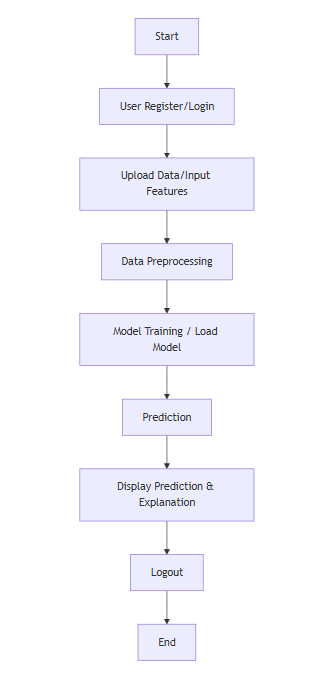
Block Diagram
Specifications
H/W CONFIGURATION:
Processor - I3/Intel Processor
Hard Disk - 160GB
Key Board - Standard Windows Keyboard
Mouse - Two or Three Button Mouse
Monitor - SVGA
RAM - 8GB
S/W CONFIGURATION:
• Operating System : Windows 7/8/10
• Server side Script : HTML, CSS, Bootstrap & JS
• Programming Language : Python
• Libraries : Flask, Pandas, MySQL. Connector, Scikit-Learn, pytorch
• IDE/Workbench : VS Code
• Technology : Python 3.8+
• Server Deployment : Xampp Server


 Paper Publishing

Request Call Back
Would you like to receive a free callback now?
Choose the best time for callback:
Leave your message and we will contact you as soon as possible

6-2-85/B, Old Maternity Hospital Road, Thyagaraja Nagar, Tirupati, Andhra Pradesh – 517501
+91 9030333433
+91 9393939065
0877-2261612

Disclaimer - Takeoff Edu Group Projects are not associated or affiliated with IEEE in any way. The IEEE Projects mentioned here are mentioned in the context of student projects, whose ideas are derived from IEEE publications, not projects of or by IEEE.

