Predicting Credit Card Fraud Detection Using Machine Learning
Objective
The primary objective of this study is to enhance the accuracy and efficiency of credit card fraud detection systems by leveraging advanced machine learning algorithms. Credit card fraud remains a critical challenge for financial institutions due to the increasing sophistication of fraudulent activities. Traditional fraud detection methods often fall short in addressing these evolving threats,
Abstract
Identification of bank cards fraud remains a serious worry for financial companies because of how sophisticated criminal behavior is becoming.. This study addresses this challenge by leveraging machine learning algorithms to enhance the accuracy and efficiency of fraud detection systems. Utilizing a dataset from Kaggle, we implement and compare five distinct algorithms: LSTM networks, neural networks based on CNN, Decision Trees, Random Forests, and a Stacking Classifier. CNNs are employed to capture intricate patterns in transaction data, while LSTM address sequential dependencies and temporal dynamics. Decision Trees and Random Forests provide robust classification through hierarchical decision-making and ensemble learning. Additionally, a Stacking Classifier integrates the strengths of these algorithms to potentially improve overall performance. The comparative analysis of these methods tries to determine the best method for real-time identification of fraud. The results are expected to contribute significantly to the development of more secure credit card transaction systems, thereby mitigating financial losses and enhancing consumer trust.
Keywords: Fraud detection, machine learning, LSTM, CNN, Decision Trees, Random Forests.
NOTE: Without the concern of our team, please don't submit to the college. This Abstract varies based on student requirements.
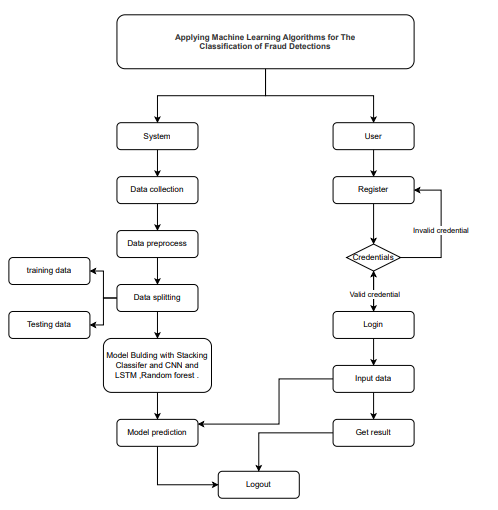
Block Diagram
Specifications
SOFTWARE REQUIREMENS
Operating System : Windows 7/8/10
Server side Script : HTML, CSS, Bootstrap & JS
Programming Language : Python
Libraries : Flask, Pandas, Mysql.connector, Os, Numpy
IDE/Workbench : PyCharm, VS-Code
Technology : Python 3.6+
Server Deployment : Xampp Server
Database : MySQL
Hardware Requirements
Operating system : Windows 7 or 7+
RAM : 8 GB
Hard disc or SSD : More than 500 GB
Processor : Intel 3rd generation or high or Ryzen with 8 GB Ram

Demo Video


Request for Video
 Paper Publishing
Request Call Back
Would you like to receive a free callback now?
Choose the best time for callback:
Leave your message and we will contact you as soon as possible

6-2-85/B, Old Maternity Hospital Road, Thyagaraja Nagar, Tirupati, Andhra Pradesh – 517501
+91 9030333433
+91 9393939065
0877-2261612

Disclaimer - Takeoff Edu Group Projects are not associated or affiliated with IEEE in any way. The IEEE Projects mentioned here are mentioned in the context of student projects, whose ideas are derived from IEEE publications, not projects of or by IEEE.

