Predicting and Understanding College Student Mental Health with Interpretable Machine Learning
Objective
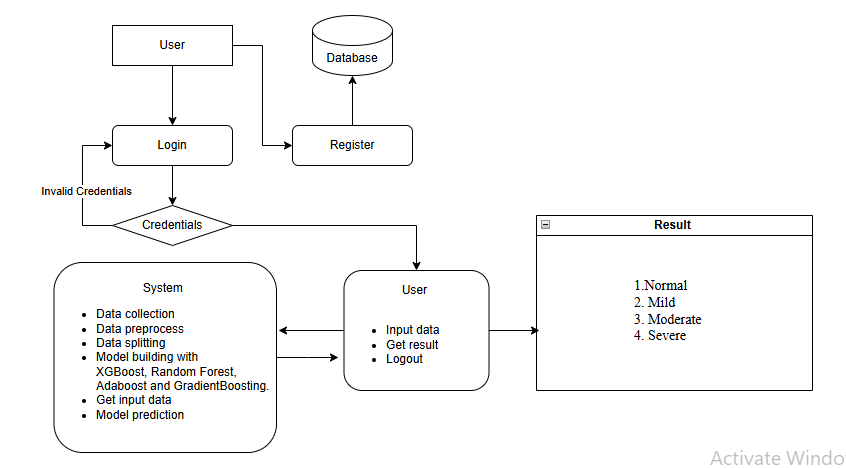
The objective of this project is to predict and understand the mental health status of college students using advanced machine learning algorithms. By utilizing a comprehensive longitudinal mobile sensing dataset, which spans five years and includes data from both pre-pandemic and pandemic periods, the project aims to provide accurate predictions of mental health conditions. The study implements models such as Random Forest, Adaboost Regressor, Gradient Boosting, and XGBoost Regressor to address the challenges of limited data and opaque machine learning models. Additionally, the project seeks to enhance model interpretability, offering transparent insights into the factors influencing student mental health.
Abstract
Mental health issues among college students have become a pressing concern, severely affecting both their academic performance and overall wellbeing. Predicting and understanding the mental health status of college students remains a complex task due to three main challenges: the limited availability of large-scale longitudinal datasets, the use of opaque black-box machine learning models, and the reliance on population-level analysis rather than personalized insights. In this study, we address these challenges by leveraging advanced machine learning algorithms to predict and interpret college student mental health. Specifically, we implement Random Forest, Adaboost Regressor, Gradient Boosting Regressor, and XGBoost Regressor to analyze a comprehensive dataset spanning five years, which includes data collected both before and during the COVID-19 pandemic. By using this dataset, which is the longest longitudinal mobile sensing dataset of its kind, we aim to provide accurate predictions and offer valuable insights into the factors affecting mental health among college students. This work not only focuses on improving prediction accuracy but also aims to enhance the interpretability of the models, providing more transparent and actionable insights for mental health professionals.
Keywords: College student mental health, machine learning, interpretable models, Random Forest, Adaboost Regressor, Gradient Boosting, XGBoost Regressor, mobile sensing dataset, longitudinal data, COVID-19 pandemic, mental health prediction, personalized analysis.
NOTE: Without the concern of our team, please don't submit to the college. This Abstract varies based on student requirements.
Block Diagram
Specifications
Hardware Requirements
Processor - I3/Intel Processor
Hard Disk - 160GB
Key Board - Standard Windows Keyboard
Mouse - Two or Three Button Mouse
Monitor - SVGA
RAM - 8GB
Software Requirements:
Operating System : Windows 7/8/10
Server side Script : HTML, CSS, Bootstrap & JS
Programming Language : Python
Libraries : Django, Pandas, Numpy, Tensorflow, Scikit-learn.
IDE/Workbench : VS Code
Technology : Python 3.10
Database : SQLite


 Paper Publishing

Request Call Back
Would you like to receive a free callback now?
Choose the best time for callback:
Leave your message and we will contact you as soon as possible

6-2-85/B, Old Maternity Hospital Road, Thyagaraja Nagar, Tirupati, Andhra Pradesh – 517501
+91 9030333433
+91 9393939065
0877-2261612

Disclaimer - Takeoff Edu Group Projects are not associated or affiliated with IEEE in any way. The IEEE Projects mentioned here are mentioned in the context of student projects, whose ideas are derived from IEEE publications, not projects of or by IEEE.

