PQD Detection & Classification Using Unsupervised Clustering Method Using DBSCAN
Objective
The primary objective of this project is to develop an effective machine learning-based system for detecting and classifying Power Quality Disturbance (PQD) events in electrical systems. Specific goals include implementing and evaluating unsupervised clustering models (DBSCAN and K-Means) together with regression models (Random Forest and XGBoost) to achieve accurate PQD identification. Model performance is rigorously assessed using key metrics such as R², RMSE, and accuracy. A secure Flask web application is built to deploy the models, supporting CSV data uploads, visualization of performance metrics, and real-time predictions. Designed for scalability and efficiency, the system provides a user-friendly interface that enables power grid operators and engineers to integrate it seamlessly into existing power quality monitoring infrastructure.
Abstract
This research presents an innovative approach for the detection and classification of PQD (Power Quality Disturbances) using unsupervised clustering methods, specifically DBSCAN (Density-Based Spatial Clustering of Applications with Noise) and K-Means. The method integrates machine learning models for predicting RMS (Root Mean Square) values and classifying power quality disturbances into distinct categories based on their features. The data is preprocessed using scaling techniques, followed by regression models (Random Forest and XGBoost) for RMS prediction. The classification task is handled using Random Forest and XGBoost models, categorizing PQD events into "Good" or "Poor" labels. Additionally, DBSCAN and K-Means are employed for clustering the data, where DBSCAN's ability to detect noise and identify non-linear clusters and K-Means's effectiveness in partitioning the data into predefined groups offer complementary benefits. The performance of these models is evaluated using standard metrics such as R², RMSE, and accuracy. The research demonstrates high accuracy and precision in PQD classification, with near-perfect regression results and strong clustering performance. This approach offers a promising solution for real-time power quality monitoring, contributing to the development of intelligent grid systems. The study advances machine learning applications in power systems monitoring, fault detection, and anomaly classification.
Keywords: PQD, Unsupervised Clustering, DBSCAN, K-Means, Power Quality Disturbances, RMS Prediction, Machine Learning, Random Forest, XGBoost, Clustering, Real-Time Monitoring.
NOTE: Without the concern of our team, please don't submit to the college. This Abstract varies based on student requirements.
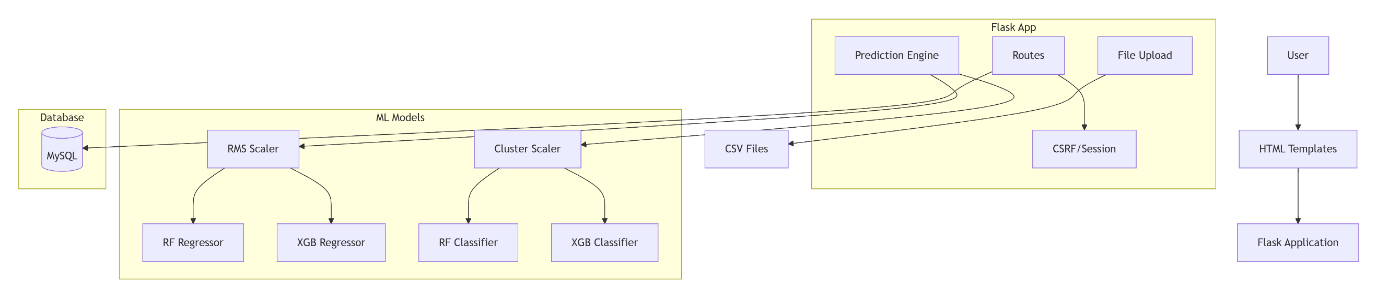
Block Diagram
Specifications
SOFTWARE REQUIREMENS
Operating System : Windows 7/8/10
Server side Script : Flask
Programming Language : Python
Libraries : Flask, Tensorflow, Pandas, Torch, Keras, Sklearn, Numpy , Seaborn
IDE/Workbench : VSCode
Server Deployment : Xampp Server
Database : mysql
HARDWARE REQUIREMENTS
Processor - I3/Intel Processor
RAM - 8GB (min)
Hard Disk - 128 GB
Key Board - Standard Windows Keyboard
Mouse - Two or Three Button Mouse
Monitor - Any


 Paper Publishing

Request Call Back
Would you like to receive a free callback now?
Choose the best time for callback:
Leave your message and we will contact you as soon as possible

6-2-85/B, Old Maternity Hospital Road, Thyagaraja Nagar, Tirupati, Andhra Pradesh – 517501
+91 9030333433
+91 9393939065
0877-2261612

Disclaimer - Takeoff Edu Group Projects are not associated or affiliated with IEEE in any way. The IEEE Projects mentioned here are mentioned in the context of student projects, whose ideas are derived from IEEE publications, not projects of or by IEEE.

