Power quality enhancement in a grid-connected hybrid system with coordinated PQ theory & fractional order PID controller in DPFC
Objective
Main objective of this project are mitigating sag, swell, and current harmonics that exist in the distribution system and load shedding that affect the consumers.
Abstract
In this project, a new FACTS-based Distributed Power Flow Controller (DPFC) that incorporates a coordinated PQ theory and a FOPID controller is proposed to mitigate the power quality issues. The power quality issues arise due to the integration of the RES with a grid. Due to the power quality issues, the grid experiences problems such as voltage sag, swell, harmonics, and load shedding that affect the consumers. To overcome the abovementioned problems, custom power devices (CPDs) are employed in the distribution system.
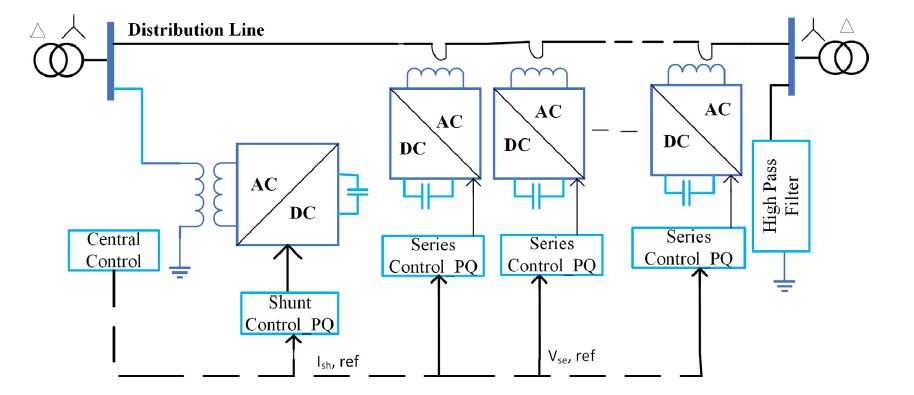
The DPFC is composed of a shunt, and a series controller mitigates sag, swell, and current harmonics that exist in the distribution system. In this study, solar and wind energy systems are considered as the source. For the validation, the results of the proposed FOPID are compared with PI, FUZZY, and ANFIS controllers. The FOPID controller shows a better voltage profile improvement in terms of the amplitude peak of transition rise/fall voltage and in compensation of the voltage with fewer oscillations.
In addition, there are also fewer ripples in the DC voltage, and the improvement of active power is implemented in the proposed DPFC-FOPID controller. Furthermore, a case study was conducted on an IEEE 12 bus system using CPDs. The study showed that the developed DPFC exhibits superior performance in terms of voltage compensation and harmonics reduction. This paper presents a DPFC-based integrated hybrid system model using a fractional order PID (FOPID) controller under the unbalanced voltage conditions in the MATLAB/Simulink environment.
Keywords: DPFC, Hybrid system, PQ theory, FOPID controller, ANFIS controller, Fuzzy controller.
NOTE: Without the concern of our team, please don't submit to the college. This Abstract varies based on student requirements.
Block Diagram
Specifications
Software Configuration:
Operating System : Windows 7/8/10
Application Software : Matlab/Simulink
Hardware Configuration:
RAM : 8 GB / 4 GB (Min)
Processor : I3 / I5(Mostly prefer)
Learning Outcomes
- Introduction to Matlab/Simulink
- What is EISPACK & LINPACK
- How to start with MATLAB
- About Matlab language
- About tools & libraries
- Application of Matlab/Simulink
- About Matlab desktop
- Features of Matlab/Simulink
- Basics on Matlab/Simulink
- Introduction to Distribution Generation Systems
- Introduction to Renewable Energy Sources
- Introduction to Solar Power System
- Introduction to Wind Power System
- Introduction to FACTS devices
- Introduction to Power Grids
- Introduction to Distributed power flow controller (DPFC)
- Introduction to custom power devices (CPDs)
- Introduction to PI, FUZZY, and ANFIS controllers
- Introduction to Fractional order PID (FOPID)
- Introduction to Total Harmonic Distortion
- Introduction to Power Quality Issues
- Introduction to PV MPPT
- Introduction to Voltage Sags and Swells
- Introduction to Hybrid Micro-Grids.
- Introduction to Point of Common Coupling (PCC)
- Introduction to Pulse Width Modulation (PWM),
- Design of DPFC.
- How to implement shunt and series converter control?
- We can learn about the Grid Synchronization
- Introduction to open loop and closed loop control system
- Introduction to Reactive Power Compensation
- Introduction to Filters
- Introduction to Voltage Source Converters (VSC)
- We can learn about different types of loads.
- Project Development Skills:
- Problem analyzing skills
- Problem solving skills
- Creativity and imaginary skills
- Programming skills
- Deployment
- Testing skills
- Debugging skills
- Project presentation skills
- Thesis writing skills
Demo Video


Request for Video
 Paper Publishing
Request Call Back
Would you like to receive a free callback now?
Choose the best time for callback:
Leave your message and we will contact you as soon as possible

6-2-85/B, Old Maternity Hospital Road, Thyagaraja Nagar, Tirupati, Andhra Pradesh – 517501
+91 9030333433
+91 9393939065
0877-2261612

Disclaimer - Takeoff Edu Group Projects are not associated or affiliated with IEEE in any way. The IEEE Projects mentioned here are mentioned in the context of student projects, whose ideas are derived from IEEE publications, not projects of or by IEEE.

