Power Consumption of LED-Based LiFi Transmitters
Objective
To analyze and evaluate the power consumption characteristics of LED-based LiFi transmitters under different operating conditions and data transmission rates. To optimize energy efficiency while maintaining reliable high-speed optical wireless communication performance in LiFi systems.
Abstract
Efficient energy monitoring and wireless communication systems are important in modern smart electrical applications. This project presents a Power Consumption Monitoring System for LED-Based LiFi Transmitters using Arduino and LiFi communication technology. The proposed system uses a PZEM sensor to monitor electrical parameters such as voltage, current, power consumption, and power factor. Two LED bulb loads of 100W and 200W are used to analyze variations in power consumption under different operating conditions. LiFi technology is used for wireless data transmission through visible light communication between the transmitter and receiver sections. LCD displays are used to show monitored electrical parameters and system conditions continuously. During abnormal electrical conditions or excessive power usage, the system activates a buzzer and a red LED indicator for alert notification. At the same time, LiFi communication transmits the abnormal condition data from the transmitter to the receiver section for monitoring and analysis. The system is powered using dual adapter power supplies for stable operation. The proposed system supports efficient power monitoring, abnormal condition detection, wireless LiFi communication, and smart energy management applications using visible light communication technology.
NOTE: Without the concern of our team, please don't submit to the college. This Abstract varies based on student requirements.
Block Diagram
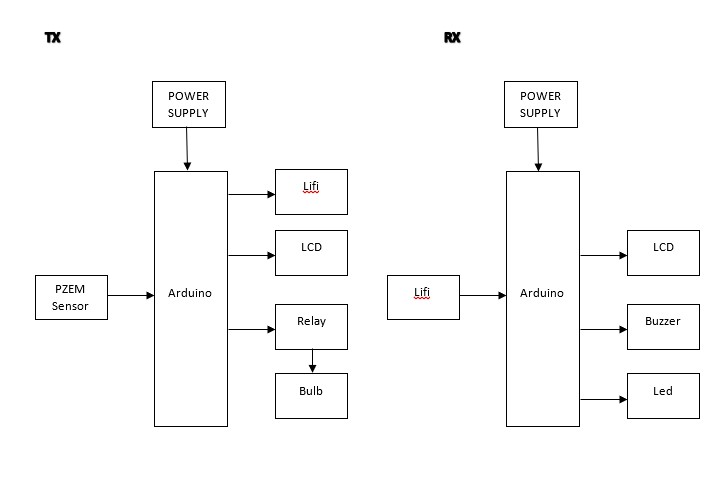
Specifications
Hardware components:
- Arduino Uno-02
- PZEM Sensor
- LED Bulb (100W)
- LED Bulb (200W)
- LiFi Module
- LCD Display-02
- Relay-02
- Buzzer
- Led
- Power Cable
- Power Supply-02
- 12V Adapter-02
- Connectors – 40
Software components:
- Embedded C
- Arduino IDE
Learning Outcomes
- Arduino pin diagram and architecture
- How to install Arduino IDE and required software
- Setting up and installation procedure for Arduino IDE
- Introduction to Arduino development environment
- Basics of Embedded C / Python programming
- Basics of IoT platforms
- Working of power supply
- About Project Development Life Cycle:
- Planning and Requirement Gathering (software’s, tools, hardware components, etc.,)
- Schematic preparation
- Code development and debugging
- Hardware development and debugging
- Development of the Project and Output testing
- Practical exposure to:
- Hardware and software tools
- Solution providing for real-time problems
- Working with team / individual
- Work on creative ideas
- Project development Skills:
- Problem analyzing skills
- Problem solving skills
- Creativity and imaginary skills
- Programming skills
- Deployment
- Testing skills
- Debugging skills
- Project presentation skills
- Thesis writing skills


 Paper Publishing

Request Call Back
Would you like to receive a free callback now?
Choose the best time for callback:
Leave your message and we will contact you as soon as possible

6-2-85/B, Old Maternity Hospital Road, Thyagaraja Nagar, Tirupati, Andhra Pradesh – 517501
+91 9030333433
+91 9393939065
0877-2261612

Disclaimer - Takeoff Edu Group Projects are not associated or affiliated with IEEE in any way. The IEEE Projects mentioned here are mentioned in the context of student projects, whose ideas are derived from IEEE publications, not projects of or by IEEE.

