Power-Area Optimized Multiplier Design using In-Memory Computation
Objective
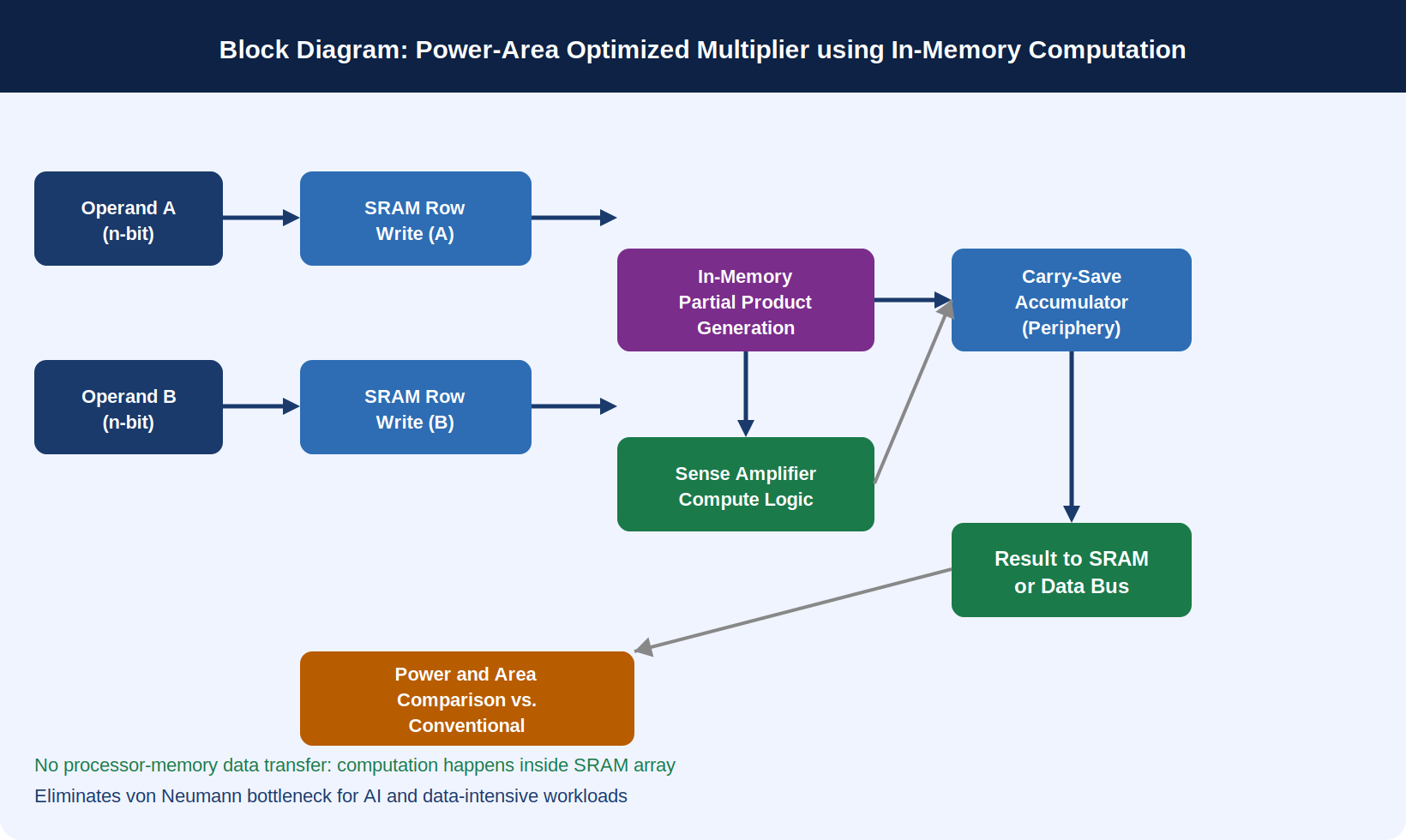
The von Neumann bottleneck arising from frequent data transfers between processor and memory has become a critical limitation in modern computing systems, particularly for data-intensive applications. In-Memory Computation (IMC) offers a promising paradigm to address this challenge by performing arithmetic operations directly within the memory array, eliminating excessive data movement. This paper presents a power-area optimized multiplier design exploiting in-memory computation techniques
Abstract
The von Neumann bottleneck arising from frequent data transfers between processor and memory has become a critical limitation in modern computing systems, particularly for data-intensive applications. In-Memory Computation (IMC) offers a promising paradigm to address this challenge by performing arithmetic operations directly within the memory array, eliminating excessive data movement. This paper presents a power-area optimized multiplier design exploiting in-memory computation techniques. The proposed multiplier leverages SRAM-based computation structures to perform multiplication using bitwise logical operations within the memory cells. The architecture is designed and evaluated using standard CMOS technology. Experimental results demonstrate significant improvements in power consumption and area footprint compared to conventional CMOS multiplier designs, making it well-suited for AI accelerators, edge computing, and energy-constrained DSP applications.
Keywords: In-Memory Computing, Multiplier, Low Power, Area Optimization, Processing-in-Memory, SRAM, CMOS, Edge Computing
NOTE: Without the concern of our team, please don't submit to the college. This Abstract varies based on student requirements.
Block Diagram
Specifications
Software Requirements
• Cadence Virtuoso / Spectre
• Verilog HDL
• MATLAB (verification)
Hardware Requirements
• CMOS 45nm / 90nm Technology
• SRAM Array Test Chip
• Logic Analyzer
Learning Outcomes
• In-Memory Computing Architecture
• SRAM-Based Arithmetic Design
• Power-Area Trade-off Optimization
• Von Neumann Bottleneck Solutions
• Data-Intensive Computing Hardware Design


 Paper Publishing

Request Call Back
Would you like to receive a free callback now?
Choose the best time for callback:
Leave your message and we will contact you as soon as possible

6-2-85/B, Old Maternity Hospital Road, Thyagaraja Nagar, Tirupati, Andhra Pradesh – 517501
+91 9030333433
+91 9393939065
0877-2261612

Disclaimer - Takeoff Edu Group Projects are not associated or affiliated with IEEE in any way. The IEEE Projects mentioned here are mentioned in the context of student projects, whose ideas are derived from IEEE publications, not projects of or by IEEE.

