Pleth-SleepNet: A Unified Network for Simultaneous Sleep Stages and Disorder Classification With PPG Signal
Objective
The objective of this project is to accurately detect and classify sleep stages and disorders using plethysmography-based signals, categorized as Healthy, Mild, Moderate, and Severe. By leveraging deep learning models—hybridCNN_GlobalPooling and LightweightAttentionCNN—the project aims to enhance the monitoring and diagnosis of sleep-related health conditions. The primary goal is to develop an automated system that can identify different levels of sleep quality and disorder severity with high precision using image-based signal representations. This system will provide valuable insights for clinical decision-making, enabling early detection and intervention for sleep disorders, thereby improving patient care and health outcomes.
Abstract
The monitoring
and diagnosis of sleep disorders have become increasingly critical in
healthcare, with traditional methods often being time-consuming and reliant on
expert interpretation. This project presents Pleth-SleepNet, a unified deep learning framework designed for simultaneous
classification of sleep stages and disorders using plethysmography-based
signals. The system leverages two advanced models: hybridCNN_GlobalPooling and LightweightAttentionCNN, which
extract temporal and spatial features effectively to differentiate among four
classes: healthy, mild, moderate, and severe. The models are trained and
evaluated using Python with Keras, achieving classification accuracies of
0.9447 and 0.9246, respectively. By implementing an image-based approach, the
framework captures complex physiological patterns, enabling robust, automated
assessment of sleep quality and disorder severity. Pleth-SleepNet offers a
scalable and efficient solution for clinical decision support, reducing manual
intervention and enhancing early detection of sleep-related health issues.
Keywords: Sleep Disorder Classification, Sleep Stage Detection, Hybrid CNN, Attention Mechanisms, Global Pooling, Deep Learning, Plethysmography, Image Classification, Healthcare Analytics, Automated Diagnosis.
NOTE: Without the concern of our team, please don't submit to the college. This Abstract varies based on student requirements.
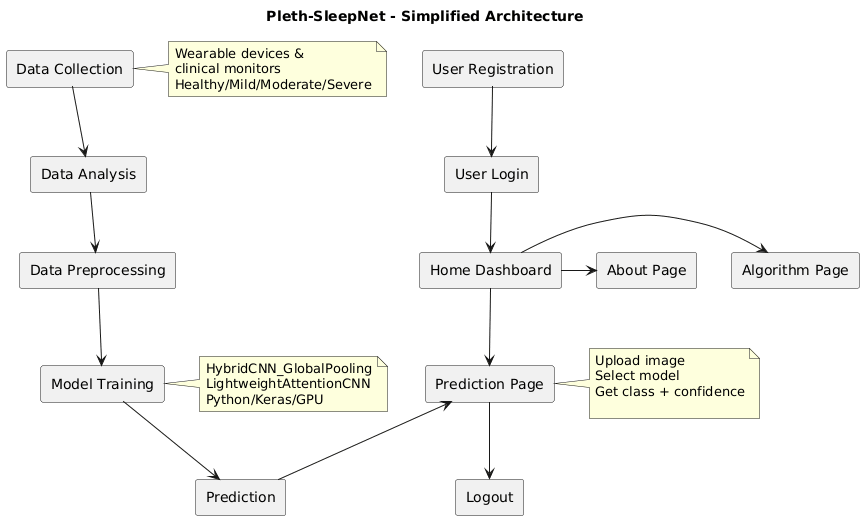
Block Diagram
Specifications
4.1 SOFTWARE REQUIREMENS
Operating System : Windows 7/8/10
Server-side Script : HTML, CSS, Bootstrap & JS
Programming Language : Python
Libraries : Flask, Pandas, Sklearn,Tensorflow NumPy, Seaborn, Matplotlib
IDE/Workbench : VSCode
Technology : Python 3.8+
Server Deployment : Xampp Server
Database : MySQL .
4.2 HARDWARE REQUIREMENTS
Processor - I5/Intel Processor
RAM - 8GB +(min)
Hard Disk - 128 +GB
Key Board - Standard Windows Keyboard
Mouse - Two or Three Button Mouse
Monitor - Any

Demo Video


Request for Video
 Paper Publishing
Request Call Back
Would you like to receive a free callback now?
Choose the best time for callback:
Leave your message and we will contact you as soon as possible

6-2-85/B, Old Maternity Hospital Road, Thyagaraja Nagar, Tirupati, Andhra Pradesh – 517501
+91 9030333433
+91 9393939065
0877-2261612

Disclaimer - Takeoff Edu Group Projects are not associated or affiliated with IEEE in any way. The IEEE Projects mentioned here are mentioned in the context of student projects, whose ideas are derived from IEEE publications, not projects of or by IEEE.

