Pineapples Health Detection Using Deep Learning Models
Objective
The objective of this project is to develop an automated system for detecting pineapple defects using deep learning models, specifically YOLOv11, YOLOv12, and YOLOv26. The system aims to classify pineapples as healthy or defective based on image analysis, utilizing pre-processed datasets. It will feature a user-friendly web interface for image uploads and live detection, providing actionable insights for quality control while ensuring scalability for future applications in agriculture.
Abstract
Abstract
This project aims to develop an efficient system for detecting defects in pineapples using advanced deep learning techniques, specifically leveraging YOLO (You Only Look Once) models YOLOv11, YOLOv12, and YOLOv26. The system classifies pineapples as either healthy or defective based on images, addressing the need for an automated quality control solution. The dataset used for training includes images of pineapples exhibiting various defects such as bruising, discoloration, and rot. The deep learning models are trained to recognize these defects, enabling the system to classify the health condition of the pineapples effectively. The project includes a live detection feature, allowing users to capture images and receive immediate feedback. The system is built using Flask and Python for the back-end, while the front-end is developed with HTML, CSS, and JavaScript, creating an intuitive and user-friendly interface. Performance evaluation metrics such as accuracy, precision, recall, and mAP (mean Average Precision) are employed to assess the effectiveness of the models. The project aims to reduce the need for manual inspection, making the defect detection process more efficient, consistent, and reliable, while offering scalability for potential future applications in other agricultural products.
Keywords: Pineapple defect detection, deep learning, YOLO models, object detection, computer vision, dataset pre-processing, image classification, Flask, precision, accuracy.
NOTE: Without the concern of our team, please don't submit to the college. This Abstract varies based on student requirements.
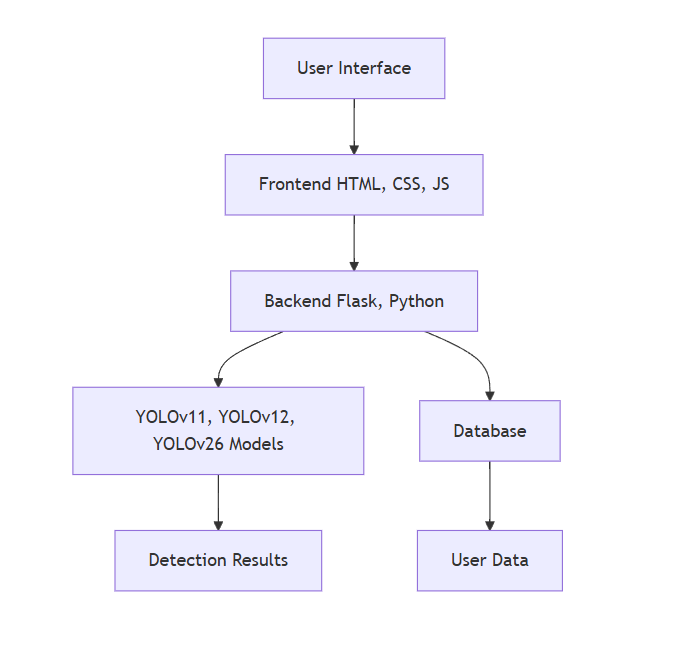
Block Diagram
Specifications
3.1 Hardware Requirements
Processor - I3/Intel Processor
Hard Disk - 160GB
Key Board - Standard Windows Keyboard
Mouse - Two or Three Button Mouse
Monitor - SVGA
RAM - 8GB
3.2 Software Requirements
Operating System : Windows 7/8/10
Programming Language : Python
Libraries : Pandas, Numpy, scikit-learn.
IDE/Workbench : Visual Studio Code.
Framework : Flask


 Paper Publishing

Request Call Back
Would you like to receive a free callback now?
Choose the best time for callback:
Leave your message and we will contact you as soon as possible

6-2-85/B, Old Maternity Hospital Road, Thyagaraja Nagar, Tirupati, Andhra Pradesh – 517501
+91 9030333433
+91 9393939065
0877-2261612

Disclaimer - Takeoff Edu Group Projects are not associated or affiliated with IEEE in any way. The IEEE Projects mentioned here are mentioned in the context of student projects, whose ideas are derived from IEEE publications, not projects of or by IEEE.

