Person Reidentification via Multi-Feature Fusion With Adaptive Graph Learning
Objective
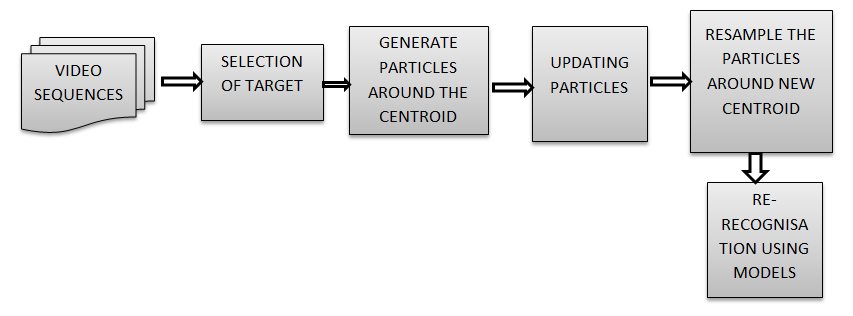
In this application we are re-identifying (Re-ID) a given pedestrian from a network of non-overlapping surveillance cameras by using a multi-feature fusion with adaptive graph learning model for unsupervised ReID.
Abstract
The goal of person reidentification (Re-ID) is to identify a given pedestrian from a network of non-overlapping surveillance cameras. Existing methods follow the supervised learning paradigm which requires pairwise labeled training data for each pair of cameras. However, this limits their scalability to real-world applications where abundant unlabeled data are available. To address this issue, we propose a multi-feature fusion with adaptive graph learning model for unsupervised ReID. Our model aims to negotiate comprehensive assessment on the consistent graph structure of pedestrians with the help of special information of feature descriptors. Specifically, we incorporate a multi-feature dictionary learning and adaptive multifeatured graph learning into a unified learning model such that the learned dictionaries are discriminative and the subsequent graph structure learning is accurate. An alternating optimization algorithm with proved convergence is developed to solve the final optimization objective
Keywords: Adaptive Graph Learning, Feature Representation Learning, Multi-Feature Fusion, Person Reidentification (Re-ID).
NOTE: Without the concern of our team, please don't submit to the college. This Abstract varies based on student requirements.
Block Diagram
Specifications
HARDWARE SPECIFICATIONS:
- Processor: I3/Intel
- Processor RAM: 4GB (min)
- Hard Disk: 128 GB
- Key Board: Standard Windows Keyboard
- Mouse: Two or Three Button Mouse
- Monitor: Any
SOFTWARE SPECIFICATIONS:
- Operating System: Windows 7+
- Server-side Script: Python 3.6+
- IDE: PyCharm
- Libraries Used: Pandas,TensorFlow,Matplotlib,Numpy.
- Frame Works:Flask.
Learning Outcomes
- What is Feature Concept.
- Preprocessing techniques.
- Scope of Real Time Application Scenarios.
- How Internet Works.
- About multi-featuring graphs.
- What is a searchengine and how browser can work.
- What type of technology versions are used.
- Use of HTML, CSS on UI Designs.
- Data Parsing Front-End to Back-End.
- Working Procedure.
- Introduction to basic technologies used for.
- How project works.
- Input and Output modules.
- Frame work use.
- Datasets properties.
- Deep learning algorithms.
- Data preprocessing methods.
- About tensor flow and keras.
- Unsupervised learning classifications.
- Project Development Skills:
- Problem analyzing skills.
- Problem solving skills.
- Creativity and imaginary skills.
- Programming skills.
- Deployment.
- Testing skills.
- Debugging skills.
- Project presentation skills.
- Thesis writing skills.


 Paper Publishing

Request Call Back
Would you like to receive a free callback now?
Choose the best time for callback:
Leave your message and we will contact you as soon as possible

6-2-85/B, Old Maternity Hospital Road, Thyagaraja Nagar, Tirupati, Andhra Pradesh – 517501
+91 9030333433
+91 9393939065
0877-2261612

Disclaimer - Takeoff Edu Group Projects are not associated or affiliated with IEEE in any way. The IEEE Projects mentioned here are mentioned in the context of student projects, whose ideas are derived from IEEE publications, not projects of or by IEEE.

