Performance of NOMA with Massive MIMO for 5G
Objective
This paper aims to evaluate the integration of NOMA with Massive MIMO and SC-FDE in 5G systems, enhancing spectral efficiency, connectivity, and reliability for IoT, URLLC, and eMBB applications.
Abstract
This paper investigates the integration and performance of Non-Orthogonal Multiple Access (NOMA) within 5G systems, particularly when combined with Massive Multiple-Input Multiple-Output (MIMO) and Single Carrier with Frequency Domain Equalization (SC-FDE). With the emergence of 5G technologies, supporting a massive number of Internet of Things (IoT) devices, ultra-reliable low-latency communications (URLLC), and enhanced mobile broadband (eMBB) is critical. NOMA stands out as a promising multiple access technique that enables spectrum sharing among users in the power domain, thereby improving spectral efficiency and supporting the massive connectivity needs of 5G networks. This study analyzes both conventional and cooperative NOMA schemes. In conventional NOMA, signals are decoded using Successive Interference Cancellation (SIC) based on their power levels. However, performance degradation can occur when lower-power users cannot be canceled, resulting in residual interference that affects higher-power users. To address this, cooperative NOMA is introduced, where lower-power users act as relays to transmit clean versions of higher-power users' signals, thereby exploiting spatial diversity and reducing interference. The paper evaluates the use of massive MIMO to enhance spatial multiplexing and system capacity and discusses the use of SC-FDE over traditional OFDM for its advantage in lowering Peak-to-Average Power Ratio (PAPR), especially beneficial in uplink transmissions. Two types of receivers are examined: Zero-Forcing (ZF), which nullifies interference through matrix inversion at the cost of noise enhancement and complexity, and Maximum Ratio Combining (MRC), which is less complex but sensitive to interference.
Keywords: NOMA, Cooperative NOMA, 5G, Massive MIMO, SC-FDE, SIC, ZF, MRC, BER, Spectrum Sharing, IoT, mm-Wave.
NOTE: Without the concern of our team, please don't submit to the college. This Abstract varies based on student requirements.
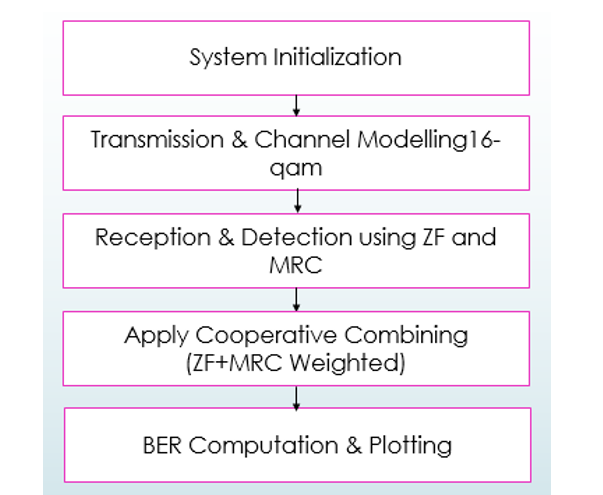
Block Diagram
Specifications
Software: Matlab 2020a or above
Hardware:
Operating Systems:
- Windows 10
- Windows 7 Service Pack 1
- Windows Server 2019
- Windows Server 2016
Processors:
Minimum: Any Intel or AMD x86-64 processor
Recommended: Any Intel or AMD x86-64 processor with four logical cores and AVX2 instruction set support
Disk:
Minimum: 2.9 GB of HDD space for MATLAB only, 5-8 GB for a typical installation
Recommended: An SSD is recommended A full installation of all MathWorks products may take up to 29 GB of disk space
RAM:
Minimum: 4 GB
Recommended: 8 GB
Learning Outcomes
· Introduction to Matlab
· What is EISPACK & LINPACK
· How to start with MATLAB
· About Matlab language
· Matlab coding skills
· About tools & libraries
· Application Program Interface in Matlab
· About Matlab desktop
· How to use Matlab editor to create M-Files
· Features of Matlab
· Basics on Matlab
· What is Communication?
· About Communication
· Introduction to Communication
· How Communication Works?
· Importing the System Design, Characterization and Visualization
· Analyzing of BER tool
· Analyzing of Error Rate Test Console
· Generation of WSN
· WSN network creation
· Nodes Communication
· Clustering
· Routing
· Convolutional
· Equalization and Synchronization etc.,
· How to extend our work to another real time applications
· Project development Skills
o Problem analyzing skills
o Problem solving skills
o Creativity and imaginary skills
o Programming skills
o Deployment
o Testing skills
o Debugging skills
o Project presentation skills
o Thesis writing skills


 Paper Publishing

Request Call Back
Would you like to receive a free callback now?
Choose the best time for callback:
Leave your message and we will contact you as soon as possible

6-2-85/B, Old Maternity Hospital Road, Thyagaraja Nagar, Tirupati, Andhra Pradesh – 517501
+91 9030333433
+91 9393939065
0877-2261612

Disclaimer - Takeoff Edu Group Projects are not associated or affiliated with IEEE in any way. The IEEE Projects mentioned here are mentioned in the context of student projects, whose ideas are derived from IEEE publications, not projects of or by IEEE.

