Performance Evaluation of Support Vector Machine and Stacked Autoencoder for Hyperspectral Image Analysis
Objective
This study evaluates Support Vector Machine (SVM) and Stacked Autoencoder (SAE) approaches for hyperspectral image classification, highlighting performance differences under varying dataset sizes, noise conditions, and computational constraints.
Abstract
In remote sensing, hyperspectral imaging has emerged as a powerful tool, capturing hundreds of spectral bands that reveal information beyond human vision. These images are invaluable for applications such as precision agriculture and environmental monitoring. However, extracting meaningful insights from hyperspectral data requires advanced analytical techniques. This research compares two popular machine learning approaches for hyperspectral image classification: support vector machines (SVM) and deep learning-based stacked autoencoders (SAE). Our goal was to evaluate their performance under diverse real-world conditions. Extensive experiments were conducted on five public hyperspectral datasets, revealing that model effectiveness depends on specific circumstances. When labeled data are limited, SVM proves more reliable and efficient. Conversely, SAE excels with abundant training data due to its ability to learn complex patterns. Incorporating active learning to select the most informative samples further enhances SAE performance on medium-sized datasets, offering a solution to data scarcity. Both methods showed sensitivity to noise, emphasizing the importance of preprocessing. While SVM requires fewer computational resources, SAE is advantageous for handling large, complex datasets with adequate infrastructure. Overall, the proposed approaches achieved high accuracy compared to existing models, providing practical guidance for researchers and practitioners in selecting suitable methods for hyperspectral image analysis based on dataset size, computational capacity, and labeling constraints.
Keywords: Hyperspectral imaging, Remote sensing, Support vector machine (SVM), Stacked autoencoder (SAE), Deep learning, Active learning, Image classification.
NOTE: Without the concern of our team, please don't submit to the college. This Abstract varies based on student requirements.
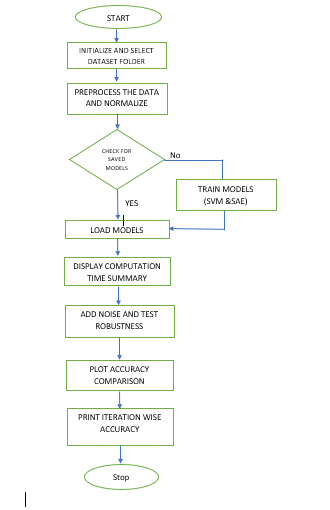
Block Diagram
Specifications
Software: Matlab 2022b or above
Hardware:
Operating Systems:
- Windows 10
- Windows 7 Service Pack 1
- Windows Server 2019
- Windows Server 2016
Processors:
Minimum: Any Intel or AMD x86-64 processor
Recommended: Any Intel or AMD x86-64 processor with four logical cores and AVX2 instruction set support
Disk:
Minimum: 2.9 GB of HDD space for MATLAB only, 5-8 GB for a typical installation
Recommended: An SSD is recommended A full installation of all MathWorks products may take up to 29 GB of disk space
RAM:
Minimum: 4 GB
Recommended: 8 GB
Learning Outcomes
· Introduction to Matlab
· What is EISPACK & LINPACK
· How to start with MATLAB
· About Matlab language
· Matlab coding skills
· About tools & libraries
· Application Program Interface in Matlab
· About Matlab desktop
· How to use Matlab editor to create M-Files
· Features of Matlab
· Basics on Matlab
· What is an Image/pixel?
· About image formats
· Introduction to Image Processing
· How digital image is formed
· Importing the image via image acquisition tools
· Analyzing and manipulation of image.
· Phases of image processing:
o Acquisition
o Image enhancement
o Image restoration
o Color image processing
o Image compression
o Morphological processing
o Segmentation etc.,
· How to extend our work to another real time applications
· Project development Skills
o Problem analyzing skills
o Problem solving skills
o Creativity and imaginary skills
o Programming skills
o Deployment
o Testing skills
o Debugging skills
o Project presentation skills
o Thesis writing skills


 Paper Publishing

Request Call Back
Would you like to receive a free callback now?
Choose the best time for callback:
Leave your message and we will contact you as soon as possible

6-2-85/B, Old Maternity Hospital Road, Thyagaraja Nagar, Tirupati, Andhra Pradesh – 517501
+91 9030333433
+91 9393939065
0877-2261612

Disclaimer - Takeoff Edu Group Projects are not associated or affiliated with IEEE in any way. The IEEE Projects mentioned here are mentioned in the context of student projects, whose ideas are derived from IEEE publications, not projects of or by IEEE.

