Performance Evaluation of Ad-Hoc Networks in Static & Mobile Environment
Objective
The main objective of this project is “To increase the network energy consumption and to present the performance evaluation of RPL in the mobile network and comparison is performed with the static network.”
Abstract
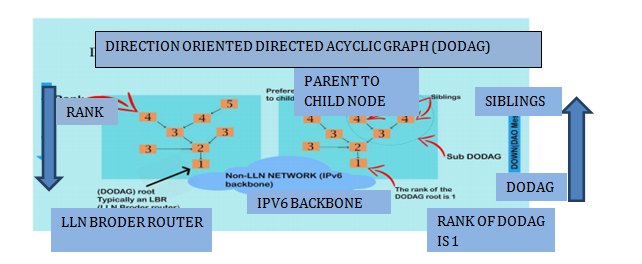
The Internet Protocol version 6 (IPv6) based routing protocol for low power and lossy networks (RPL) is used for routing in the static networks such as wireless sensor networks (WSNs) and internet of things (IoT). This implements the RPL for mobile networks like vehicular ad-hoc network (VANET) and mobile ad-hoc network (MANET).
There are some limitations of the RPL when the network is dense and mobility is introduced in it. So, to overcome this problem, the implementation is done on the Contiki environment and results are analysed on Cooja (network simulator). It is observed that the RPL performance depends strongly on number of sender nodes, sink nodes, and also on the inclusion of mobility to the nodes. The metric values increase with more packet loss with increasing the number of nodes in the network. This mobility increases the network energy consumption.
Keywords: Cooja, Directed Acyclic Graph (DAG), Destination Oriented DAG (DODAG), Internet Of Things (Iot), Low Power Lossy Network (LLN), Mobile Ad-Hoc Network (MANET), Routing Protocol For Low Power And Lossy Networks (RPL), Vehicular Ad-Hoc Network (VANET), Wireless Sensor Network (WSN).
NOTE: Without the concern of our team, please don't submit to the college. This Abstract varies based on student requirements.
Block Diagram
Specifications
HARDWARE SPECIFICATIONS:
- System: Pentium IV 2.4 GHz.
- Hard Disk: 40 GB.
- Floppy Drive: 1.44 Mb.
- Monitor: 15 VGA Colour.
- Mouse : Logitech.
- Ram: 512 Mb.
SOFTWARE SPECIFICATIONS:
- Operating system: Windows XP/7/LINUX.
- Implementation: NS2
- NS2 Version: NS2.2.34
- Front End: OTCL (Object Oriented Tool Command Language)
- Tool: Fedora (To simulate in Linux OS)
Learning Outcomes
- What is Directed acyclic graph?
- Internet of Things.
- Difference between random and static networks.
- What is Wireless sensor network?
- What is network simulation?
- What is Tomcat server and how they can work?
- What type of technology versions is used?
- Data Parsing Front-End to Back-End.
- Need of Eclipse-IDE to develop a web application.
- Working Procedure.
- Testing Techniques.
- Error Correction mechanisms.
- How to run and deploy the applications?
- Introduction to basic technologies used for.
- How project works?
- Input and Output modules.
- How to test the project based on user inputs and observe the output?
- Practical exposure to software tools and solution providing for real time problems working with team/ individual work on Creative ideas.
- Learn about types of algorithms and how to use?
- Project Development Skills:
- Problem analyzing skills.
- Problem solving skills.
- Creativity and imaginary skills.
- Programming skills.
- Deployment.
- Testing skills.
- Debugging skills.
- Project presentation skills.
- Thesis writing skills.


 Paper Publishing

Request Call Back
Would you like to receive a free callback now?
Choose the best time for callback:
Leave your message and we will contact you as soon as possible

6-2-85/B, Old Maternity Hospital Road, Thyagaraja Nagar, Tirupati, Andhra Pradesh – 517501
+91 9030333433
+91 9393939065
0877-2261612

Disclaimer - Takeoff Edu Group Projects are not associated or affiliated with IEEE in any way. The IEEE Projects mentioned here are mentioned in the context of student projects, whose ideas are derived from IEEE publications, not projects of or by IEEE.

