Performance Enhancement of V2V Communication by QC-LDPC Code and NOMA-UM-MIMO Techniques
Objective
This project aims to enhance V2V communication reliability and capacity by integrating QC-LDPC coding, NOMA, and UM-MIMO under Rician fading using MATLAB-based performance evaluation.
Abstract
Vehicle-to-Vehicle (V2V) communication plays a crucial role in ensuring traffic safety and efficient data exchange in intelligent transportation systems. However, challenges such as high mobility, severe fading, and interference degrade performance. This project proposes an integrated system combining Quasi-Cyclic Low-Density Parity-Check (QC-LDPC) coding without Girth4 cycles with Non-Orthogonal Multiple Access (NOMA) and Underlay MIMO (UM-MIMO) techniques to enhance V2V communication reliability and capacity. Analytical derivations and MATLAB simulations evaluate Bit Error Rate (BER), outage probability, and sum rate performance for near and far users under Rician fading conditions. Results demonstrate significant improvements in spectral efficiency and error correction compared to conventional OFDMA-LDPC and SM-NOMA systems. The proposed approach utilizes Successive Interference Cancellation (SIC) and Sum-Product decoding to achieve robust data transmission even at high vehicular speeds. Therefore, integrating QC-LDPC codes with NOMA-UM-MIMO proves effective for next-generation V2V communication systems.
Keywords: V2V communication; NOMA; QC-LDPC; UM-MIMO; BER; outage probability; sum rate; SIC; Rician fading.
NOTE: Without the concern of our team, please don't submit to the college. This Abstract varies based on student requirements.
Block Diagram
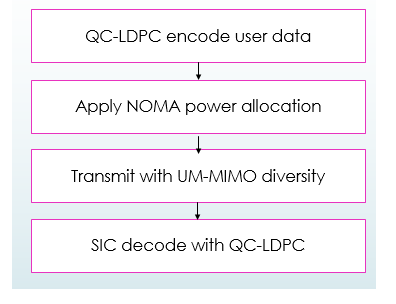
Specifications
Software: Matlab 2022b or above
Hardware:
Operating Systems:
- Windows 10
- Windows 7 Service Pack 1
- Windows Server 2019
- Windows Server 2016
Processors:
Minimum: Any Intel or AMD x86-64 processor
Recommended: Any Intel or AMD x86-64 processor with four logical cores and AVX2 instruction set support
Disk:
Minimum: 2.9 GB of HDD space for MATLAB only, 5-8 GB for a typical installation
Recommended: An SSD is recommended A full installation of all MathWorks products may take up to 29 GB of disk space
RAM:
Minimum: 4 GB
Recommended: 8 GB

Demo Video


Request for Video
 Paper Publishing
Request Call Back
Would you like to receive a free callback now?
Choose the best time for callback:
Leave your message and we will contact you as soon as possible

6-2-85/B, Old Maternity Hospital Road, Thyagaraja Nagar, Tirupati, Andhra Pradesh – 517501
+91 9030333433
+91 9393939065
0877-2261612

Disclaimer - Takeoff Edu Group Projects are not associated or affiliated with IEEE in any way. The IEEE Projects mentioned here are mentioned in the context of student projects, whose ideas are derived from IEEE publications, not projects of or by IEEE.

