Performance Comparison of 16-Bit ALU and 32-Bit ALU Using Verilog
Objective
The objective of this project is to design and implement both 16-bit and 32-bit ALUs using Verilog. It aims to compare their performance based on key metrics such as speed, area, and power consumption.
Abstract
The increasing demand for efficient and high-performance embedded systems drives the need for optimized Arithmetic and Logic Units (ALUs), which are fundamental to their operation. This study aims to address the trade-offs in area, propagation delay, and power consumption, ensuring balanced performance for diverse applications. The study compares the performance of 16-bit and 32-bit ALUs, focusing on key metrics such as area, propagation delay, and power consumption. A trade-off between area and power dissipation is observed, with the 32-bit ALU consuming more power and occupying more area than the 16-bit ALU. To ensure low power consumption, the design activates only one operation and circuit set at a time. The Artix7 FPGA board is utilized to evaluate and compare the performance, with simulations conducted using Verilog and the Xilinx vivado software tool. This study presents the design and analysis of a 16-bit Register Transfer Level (RTL) ALU, showcasing its architectural efficiency with reduced complexity through functional blocks such as adders, subtractors, and logic gates. Synthesis results demonstrate optimized technology schematics using Xilinx specific components, LUTs and carry logic, ensuring enhanced performance and early issue detection.
Keywords—ALU, power consumption, propagation delay and area.
NOTE: Without the concern of our team, please don't submit to the college. This Abstract varies based on student requirements.
Block Diagram
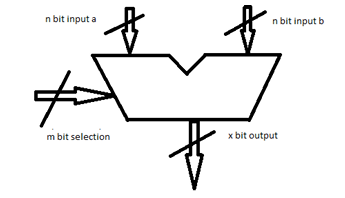
Specifications
Specifications
Software Requirements
- Xilinx Vivado Design Suite (2020.2 or later)
- Verilog HDL for RTL design and implementation
- Vivado Simulator (XSIM) for functional and timing verification
Hardware Requirements
- Microsoft® Windows 10 / Windows 11 (64-bit)
- Intel® Core™ i5 / i7 Processor or equivalent
- Minimum 8 GB RAM
- Minimum 500 MB free disk space
Learning Outcomes
Understand the architectural differences between 16-bit and 32-bit Arithmetic Logic Units (ALUs) and their impact on computational performance.
Gain hands-on experience in designing, coding, and verifying parameterized ALU architectures using Verilog HDL.
Analyze and compare key performance metrics such as area (LUTs/slices), delay, power consumption, and throughput for different word lengths.
Learn to use Xilinx Vivado tools for synthesis, simulation, and timing analysis of digital designs.
Develop the ability to interpret trade-offs between bit-width scaling and hardware resource utilization in FPGA implementations.
Strengthen skills in performance evaluation and result interpretation for digital VLSI and FPGA-based systems.


 Paper Publishing

Request Call Back
Would you like to receive a free callback now?
Choose the best time for callback:
Leave your message and we will contact you as soon as possible

6-2-85/B, Old Maternity Hospital Road, Thyagaraja Nagar, Tirupati, Andhra Pradesh – 517501
+91 9030333433
+91 9393939065
0877-2261612

Disclaimer - Takeoff Edu Group Projects are not associated or affiliated with IEEE in any way. The IEEE Projects mentioned here are mentioned in the context of student projects, whose ideas are derived from IEEE publications, not projects of or by IEEE.

