Performance Analysis of SRAM Cell Designed using MOS and Floating-gate MOS for Ultralow Power Technology
Objective
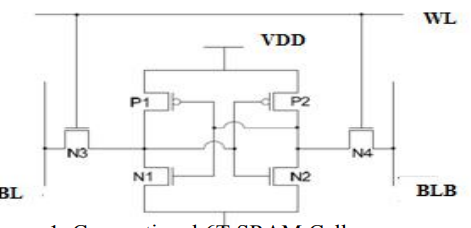
The primary objective appears to be analyzing and comparing the performance of SRAM cells designed using two different technologies: MOS (Metal-Oxide-Semiconductor) and Floating-gate MOS, with a focus on ultralow power applications
Abstract
In modern VLSI systems, Static Random Access Memory (SRAM) plays a crucial role as a primary storage element, directly influencing the performance, power efficiency, and reliability of integrated circuits. Conventional SRAM cells designed using MOS transistors face challenges such as increased leakage current, higher standby power, and scaling limitations in advanced technology nodes. To address these issues, Floating-Gate MOS (FGMOS) devices have emerged as a promising alternative due to their ability to achieve programmable threshold voltages, reduced leakage paths, and improved charge retention characteristics. This work presents a comparative performance analysis of SRAM cells designed using conventional MOSFETs and FGMOS devices for ultralow-power technology applications. The study focuses on key design parameters including power consumption, static noise margin (SNM), delay, and area efficiency. Simulation results demonstrate that FGMOS-based SRAM cells significantly reduce leakage power while maintaining stable read/write operations, thereby enhancing energy efficiency without compromising reliability. The proposed approach highlights the potential of FGMOS-based SRAM design as a viable solution for next-generation low-power memory architectures, particularly in applications such as IoT devices, biomedical implants, and portable electronics.
NOTE: Without the concern of our team, please don't submit to the college. This Abstract varies based on student requirements.
Block Diagram

Learning Outcomes
-
Understand the fundamental structure and working principle of SRAM cells and their role in modern VLSI systems.
-
Analyze the limitations of conventional MOSFET-based SRAM cells in terms of power consumption, leakage currents, and scalability.
-
Gain knowledge of Floating-Gate MOS (FGMOS) devices and their unique features such as programmable threshold voltage and charge retention.
-
Develop skills in designing and simulating SRAM cells using both MOS and FGMOS technologies in a circuit design environment.
-
Evaluate critical performance parameters of SRAM cells, including power consumption, static noise margin (SNM), delay, and area efficiency.
-
Compare and contrast the behavior of MOS-based and FGMOS-based SRAM cells under ultralow-power operation conditions.
-
Explore how device-level modifications (such as FGMOS) impact overall circuit-level performance in memory design.
-
Strengthen problem-solving abilities in addressing low-power design challenges in advanced CMOS technologies.
-
Apply simulation tools to verify the functionality and reliability of SRAM architectures in low-power applications.
-
Demonstrate awareness of practical applications of low-power SRAM design in IoT, biomedical, and portable electronic systems.
Demo Video


Request for Video
 Paper Publishing
Request Call Back
Would you like to receive a free callback now?
Choose the best time for callback:
Leave your message and we will contact you as soon as possible

6-2-85/B, Old Maternity Hospital Road, Thyagaraja Nagar, Tirupati, Andhra Pradesh – 517501
+91 9030333433
+91 9393939065
0877-2261612

Disclaimer - Takeoff Edu Group Projects are not associated or affiliated with IEEE in any way. The IEEE Projects mentioned here are mentioned in the context of student projects, whose ideas are derived from IEEE publications, not projects of or by IEEE.

