Performance Analysis of MAC Unit with Various Parallel Adders
Also Available Domains Arithmetic Core|Communications
Objective
To evaluate the performance of a multiply-accumulate (MAC) unit using different parallel adder architectures to determine trade-offs in speed, area, and power. To identify the best adder choice for MAC-based applications by comparing latency, resource utilization, and energy efficiency across implementations.
Abstract
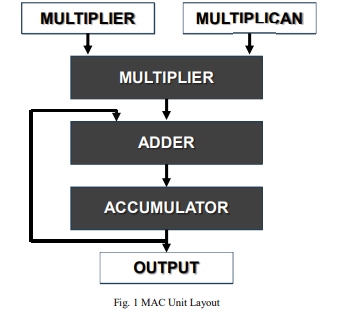
The Multiply-Accumulate (MAC) Unit is a crucial component in all DSP Applications, due to its ability to perform high speed arithmetic operations. This research aims to design and implement an 8-bit MAC Unit capable of performing multiplication and accumulation operations. The MAC Unit employs the same multiplier but integrates different adders such as Kogge-Stone, Ladner-Fischer, Carry Look-Ahead adder, and Ripple Carry Adder. The structures were formed using Verilog Hardware Description Language (HDL) and implemented on Xilinx Vivado
Keywords—MAC Unit, Kogge-Stone, Ladner-Fischer, Verilog HDL, Multiplier
NOTE: Without the concern of our team, please don't submit to the college. This Abstract varies based on student requirements.
Block Diagram
Specifications
Software Requirements:
· Xilinx Vivado Tool
· HDL: Verilog
Hardware Requirements:
· Microsoft® Windows XP
· Intel® Pentium® 4 processor or Pentium 4 equivalent with SSE support
· 512 MB RAM
· 100 MB of available disk space
Learning Outcomes
Understand the architecture and operation of a Multiply–Accumulate (MAC) unit and its role in DSP and signal processing applications.
Gain knowledge of different parallel adder architectures (Ripple Carry, Carry Look-Ahead, Carry Save, Brent–Kung, Kogge–Stone, etc.) and their integration within a MAC unit.
Design and implement MAC units with multiple adder variants using Verilog HDL.
Analyze and compare performance metrics such as area, delay, power consumption, and throughput for each parallel adder–based MAC design.
Learn to use Xilinx Vivado for synthesis, simulation, and timing/power analysis of FPGA-based MAC architectures.
Develop the ability to evaluate trade-offs between speed, hardware complexity, and power efficiency in high-performance arithmetic units.


 Paper Publishing

Request Call Back
Would you like to receive a free callback now?
Choose the best time for callback:
Leave your message and we will contact you as soon as possible

6-2-85/B, Old Maternity Hospital Road, Thyagaraja Nagar, Tirupati, Andhra Pradesh – 517501
+91 9030333433
+91 9393939065
0877-2261612

Disclaimer - Takeoff Edu Group Projects are not associated or affiliated with IEEE in any way. The IEEE Projects mentioned here are mentioned in the context of student projects, whose ideas are derived from IEEE publications, not projects of or by IEEE.

