Performance Analysis of Intrusion Detection Systems Using a Feature Selection Method on the UNSW NB15 Dataset
Objective
The main objective of the project is to detect the intrusion using UNSW-NB15 dataset and machine learning techniques.
Abstract
Computer networks intrusion detection systems (IDSs) and intrusion prevention systems (IPSs) are critical aspects that contribute to the success of an organization. Over the past years, IDSs and IPSs using different approaches have been developed and implemented to ensure that computer networks within enterprises are secure, reliable and available. In this paper, we focus on IDSs that are built using machine learning (ML) techniques. IDSs based on ML methods are effective and accurate in detecting networks attacks. However, the performance of these systems decreases for high dimensional data spaces. Therefore, it is crucial to implement an appropriate feature extraction method that can prune some of the features that do not possess a great impact in the classification process. Moreover, many of the ML based IDSs suffer from an increase in false positive rate and a low detection accuracy when the models are trained on highly imbalanced datasets. In this paper, we present an analysis the UNSW-NB15 intrusion detection dataset that will be used for training and testing our models. Moreover, we apply a flter-based feature reduction technique using the XGBoost algorithm. We then implement the following ML approaches using the reduced feature space: Support Vector Machine (SVM), k-Nearest-Neighbour (kNN), Logistic Regression (LR), Artifcial Neural Network (ANN) and Decision Tree (DT). In our experiments, we considered both the binary and multiclass classification configurations. The results demonstrated that the XGBoost-based feature selection method allows for methods such as the DT to increase its test accuracy the binary classification scheme.
Keywords: Machine learning, Feature engineering, Computer networks, Intrusion detection.
NOTE: Without the concern of our team, please don't submit to the college. This Abstract varies based on student requirements.
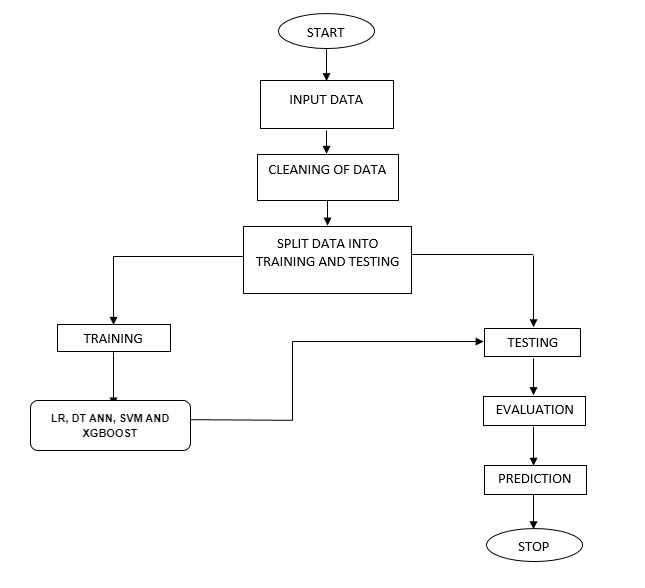
Block Diagram
Specifications
H/W Configuration:
- Processor: I3/Intel Processor
- Hard Disk:160 GB
- RAM: 8 GB
S/W Configuration:
- Operating System: Windows 7/8/10 .
- Server side Script: HTML, CSS & JS.
- IDE: Pycharm.
- Libraries Used: Numpy, IO, OS, Flask, keras.
- Technology : Python 3.6+.
Learning Outcomes
· About Python.
· About PyCharm.
· About Pandas.
· About Numpy.
· About HTML.
· About CSS.
About JavaScript.


 Paper Publishing

Request Call Back
Would you like to receive a free callback now?
Choose the best time for callback:
Leave your message and we will contact you as soon as possible

6-2-85/B, Old Maternity Hospital Road, Thyagaraja Nagar, Tirupati, Andhra Pradesh – 517501
+91 9030333433
+91 9393939065
0877-2261612

Disclaimer - Takeoff Edu Group Projects are not associated or affiliated with IEEE in any way. The IEEE Projects mentioned here are mentioned in the context of student projects, whose ideas are derived from IEEE publications, not projects of or by IEEE.

