Peev Parse Encrypt Execute Verify a Verifiable Framework
Objective
The objective of this project is to develop the PEEV (Parse, Encrypt, Execute, Verify) framework, which addresses data confidentiality concerns in cloud computing by enabling secure, remote computation on encrypted data. The framework simplifies the process of writing and verifying programs without requiring cryptographic knowledge
Abstract
Cloud computing enables users to store data and perform computations remotely, but concerns about data confidentiality persist. Traditional cryptography protects static data but cannot process encrypted data. Homomorphic encryption allows operations on encrypted data but risks result integrity if the cloud provider is dishonest. To address these issues, we introduce PEEV (Parse, Encrypt, Execute, Verify), a framework that simplifies writing and verifying programs on encrypted data without requiring cryptographic expertise. PEEV integrates homomorphic encryption with zero-knowledge proofs to ensure privacy and verifiability of computations, offering practical performance with minimal overhead and high-level programming abstractions.
KEY WORDS: Cloud computing, homomorphic encryption, private and verifiable computation, zeroknowledge proofs.
NOTE: Without the concern of our team, please don't submit to the college. This Abstract varies based on student requirements.
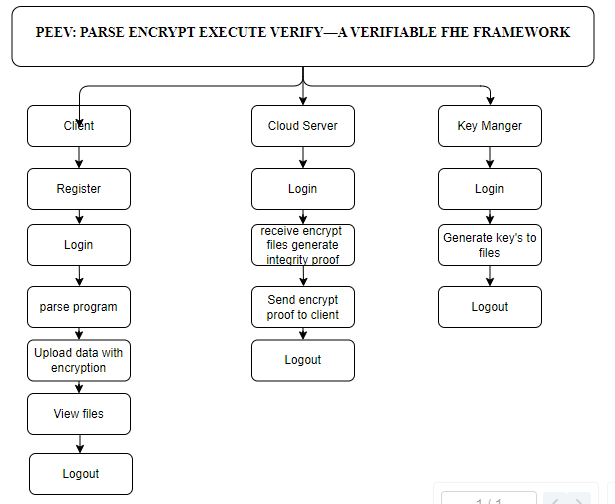
Block Diagram
Specifications
H/W CONFIGURATION:
Processor - I3/Intel Processor
Hard Disk - 160GB
Key Board - Standard Windows Keyboard
Mouse - Two or Three Button Mouse
Monitor - SVGA
RAM - 8GB
S/W CONFIGURATION:
• Operating System : Windows 7/8/10
• Server side Script : HTML, CSS, Bootstrap & JS
• Programming Language : Python
• Libraries : Django, Pandas, Mysql.connector, Os, Smtplib, Numpy
• IDE/Workbench : PyCharm
• Technology : Python 3.6+
• Server Deployment : Xampp Server

Demo Video


Request for Video
 Paper Publishing
Request Call Back
Would you like to receive a free callback now?
Choose the best time for callback:
Leave your message and we will contact you as soon as possible

6-2-85/B, Old Maternity Hospital Road, Thyagaraja Nagar, Tirupati, Andhra Pradesh – 517501
+91 9030333433
+91 9393939065
0877-2261612

Disclaimer - Takeoff Edu Group Projects are not associated or affiliated with IEEE in any way. The IEEE Projects mentioned here are mentioned in the context of student projects, whose ideas are derived from IEEE publications, not projects of or by IEEE.

