PDF Malware Detection using specific classes: Toward Machine Learning Modeling With Explainability Analysis
Objective
The project develops a machine learning system for detecting malware in PDFs using various algorithms, aiming for high accuracy, interpretability, and real-time threat mitigation.
Abstract
In the digital age, PDF files are widely used for document sharing, but their popularity also makes them a target for malware attacks. This project, titled "PDF Malware Detection: Toward Machine Learning Modeling With Explainability Analysis," aims to develop and evaluate machine learning models for detecting malware in PDF files. Utilizing a dataset from Kaggle, which contains labeled examples of malicious and benign PDFs, various algorithms including Random Forest, C5.0, J48, Support Vector Machine (SVM), AdaBoost, Deep Neural Network (DNN), Gradient Boosting Machine (GBM), and K-Nearest Neighbors (KNN) will be applied. The primary focus is on achieving high detection accuracy while also providing explainability to understand the decision-making process of the models. By leveraging machine learning techniques, this project seeks to enhance cybersecurity measures, offering a robust solution to identify and mitigate potential threats embedded in PDF documents.
Keywords: PDF malware detection, machine learning, Random Forest, SVM, DNN, explainability, cybersecurity, malicious PDF, classification algorithms, Kaggle dataset.
NOTE: Without the concern of our team, please don't submit to the college. This Abstract varies based on student requirements.
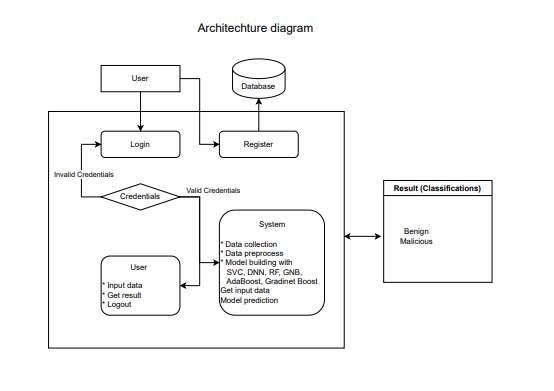
Block Diagram
Specifications
Hardware Requirements:
Operating system : Windows 7 or 7+
RAM : 8 GB
Hard disc or SSD : More than 500 GB
Processor : Intel 3rd generation or high or Ryzen with 8 GB Ram
Software Requirements:
Software’s : Python 3.10 or high version
IDE : Visual Studio Code.
Framework : Flask

Demo Video


Request for Video
 Paper Publishing
Request Call Back
Would you like to receive a free callback now?
Choose the best time for callback:
Leave your message and we will contact you as soon as possible

6-2-85/B, Old Maternity Hospital Road, Thyagaraja Nagar, Tirupati, Andhra Pradesh – 517501
+91 9030333433
+91 9393939065
0877-2261612

Disclaimer - Takeoff Edu Group Projects are not associated or affiliated with IEEE in any way. The IEEE Projects mentioned here are mentioned in the context of student projects, whose ideas are derived from IEEE publications, not projects of or by IEEE.

