Passivity-Based Control Strategy With Improved Robustness for Single-Phase Three-Level T-Type Rectifiers
Objective
The main objective of this project is to improve the robustness for single-phase three-level T-Type Rectifiers.
Abstract
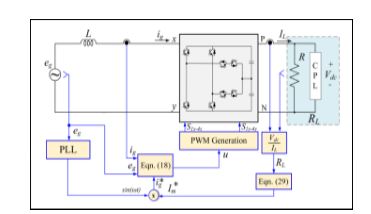
In this project, a passivity-based control (PBC) strategy with improved robustness for single-phase three-level rectifiers feeding resistive and constant power loads (CPLs) is proposed. It is shown that the control of the rectifier can be achieved if the damping injection is applied to the grid current only. In this case, the knowledge of load resistance is required in the computation of reference grid current amplitude. Since the output voltage and load current are dc quantities, the load resistance can be estimated easily. Then, the amplitude of the reference grid current is calculated from the power balance equation of the rectifier.
The transfer function from reference grid current to actual grid current is derived. The derived transfer function is analyzed under variations in the filter inductance. The results reveal that the proposed PBC offers strong robustness to variations in the filter inductance when a suitable damping gain is selected. The performances of the proposed PBC strategy under undistorted and distorted grid voltage as well as, variations in inductor are investigated via experimental studies during steady-state and transients caused by the resistive load and CPL changes. In all cases, the output voltage is regulated at the desired value, and grid current tracks its reference.
Keywords: Passivity-based control, damping injection, three-level T-type rectifier, constant power load.NOTE: Without the concern of our team, please don't submit to the college. This Abstract varies based on student requirements.
Block Diagram
Specifications
Software Configuration:
Operating System : Windows 7/8/10
Application Software : Matlab/Simulink
Hardware Configuration:
RAM : 8 GB
Processor : I3 / I5(Mostly prefer)
Learning Outcomes
- Introduction to Matlab/Simulink
- What is EISPACK & LINPACK
- How to start with MATLAB
- About Matlab language
- About tools & libraries
- Application of Matlab/Simulink
- About Matlab desktop
- Features of Matlab/Simulink
- Basics on Matlab/Simulink
- Introduction to controllers.
- Study of PWM techniques.
- Project Development Skills:
- Problem analyzing skills
- Problem solving skills
- Creativity and imaginary skills
- Programming skills
- Deployment
- Testing skills
- Debugging skills
- Project presentation skills
- Thesis writing skills


 Paper Publishing

Request Call Back
Would you like to receive a free callback now?
Choose the best time for callback:
Leave your message and we will contact you as soon as possible

6-2-85/B, Old Maternity Hospital Road, Thyagaraja Nagar, Tirupati, Andhra Pradesh – 517501
+91 9030333433
+91 9393939065
0877-2261612

Disclaimer - Takeoff Edu Group Projects are not associated or affiliated with IEEE in any way. The IEEE Projects mentioned here are mentioned in the context of student projects, whose ideas are derived from IEEE publications, not projects of or by IEEE.

