Overview on Latch-Up Prevention in CMOS Integrated Circuits by Circuit Solutions
Objective
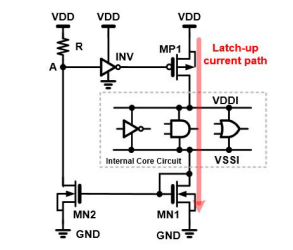
An overview on circuit methodology used to prevent latch-up issues in CMOS integrated circuits (ICs) is presented in this article.
Abstract
Latch-up is a persistent and detrimental phenomenon in CMOS integrated circuits that can lead to device malfunction, performance degradation, and even permanent damage. This paper provides a comprehensive overview of the various circuit-level solutions employed to prevent latch-up in CMOS technology. To provide practical insights, the paper also discusses the trade-offs inherent in latch-up prevention strategies, considering factors such as area overhead, power consumption, and performance impact. Additionally, it highlights the importance of simulation and testing methodologies for assessing the effectiveness of latch-up prevention measures in CMOS ICs.
NOTE: Without the concern of our team, please don't submit to the college. This Abstract varies based on student requirements.
Block Diagram
Specifications
Software Requirements:
· Tool: Tanner EDA
· Technology: 45nm
Hardware Requirements:
- Microsoft® Windows XP
- Intel® Pentium® 4 processor or Pentium 4 equivalent with SSE support
- 512 MB RAM
- 100 MB of available disk space
Learning Outcomes
· Introduction to digital & analog electronics
· Knowledge of MOSFETs
o Operation and characteristics of PMOS & NMOS
o Knowledge on Threshold voltages
· Basics of Latch
o Operation of Latch & its applications
· Importance of Latch-up in analog electronics
· Knowledge on CMOS Configuration
· Knowledge on Tool Learning


Related Projects
 Paper Publishing

Request Call Back
Would you like to receive a free callback now?
Choose the best time for callback:
Leave your message and we will contact you as soon as possible

6-2-85/B, Old Maternity Hospital Road, Thyagaraja Nagar, Tirupati, Andhra Pradesh – 517501
+91 9030333433
+91 9393939065
0877-2261612

Disclaimer - Takeoff Edu Group Projects are not associated or affiliated with IEEE in any way. The IEEE Projects mentioned here are mentioned in the context of student projects, whose ideas are derived from IEEE publications, not projects of or by IEEE.

