OTP based smart wireless locking system using Arduino
Objective
The objective of the Vehicle Immobilizer using Fingerprint and Keypad project is to develop a secure vehicle authentication system that allows access only to authorized users using fingerprint and password verification. The system aims to prevent unauthorized vehicle access, improve security, and provide reliable protection through biometric and password-based authentication.
Abstract
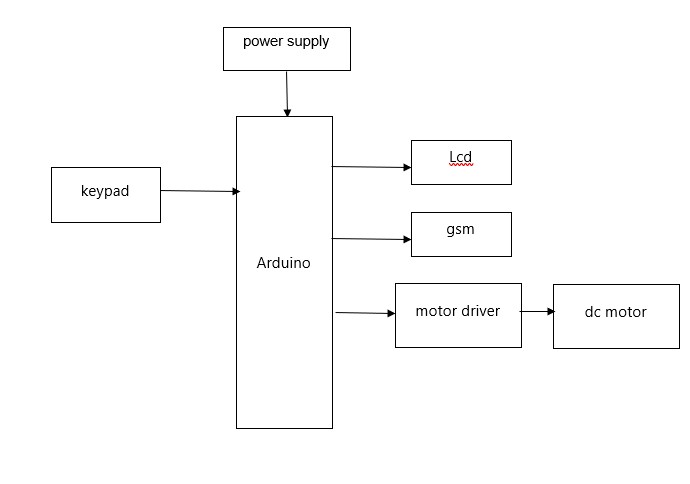
The OTP-Based Smart Wireless Locking System Using Arduino is an innovative security solution that ensures controlled access through one-time password (OTP) authentication. The system integrates an Arduino microcontroller to manage sensor inputs, OTP verification, and motor operations. A keypad allows users to input the OTP received on their registered mobile number via the GSM module, while an LCD provides real-time status updates. Upon successful authentication, the Arduino activates the motor driver to operate a DC motor that physically unlocks the door. The system is powered using a 12V adapter and regulated power supply, ensuring stable performance. This setup offers a secure, wireless, and user-friendly locking mechanism, making it suitable for residential, commercial, and restricted-access environments. The project highlights cost-effective implementation of smart security using readily available electronic components.
NOTE: Without the concern of our team, please don't submit to the college. This Abstract varies based on student requirements.
Block Diagram
Specifications
Hardware components:
- Arduino
- lcd
- keypad
- gsm
- motor driver
- dc motor
- power supply
- 12v Adapater
- connectors-30.
Software components:
- Arduino ide
- Embedded c
Learning Outcomes
- Arduino pin diagram and architecture
- How to install Arduino IDE and required software
- Setting up and installation procedure for Arduino IDE
- Introduction to Arduino development environment
- Basics of Embedded C / Python programming
- Basics of IoT platforms
- Working of power supply
- About Project Development Life Cycle:
- Planning and Requirement Gathering (software’s, tools, hardware components, etc.,)
- Schematic preparation
- Code development and debugging
- Hardware development and debugging
- Development of the Project and Output testing
- Practical exposure to:
- Hardware and software tools
- Solution providing for real-time problems
- Working with team / individual
- Work on creative ideas
- Project development Skills:
- Problem analyzing skills
- Problem solving skills
- Creativity and imaginary skills
- Programming skills
- Deployment
- Testing skills
- Debugging skills
- Project presentation skills
- Thesis writing skills


 Paper Publishing

Request Call Back
Would you like to receive a free callback now?
Choose the best time for callback:
Leave your message and we will contact you as soon as possible

6-2-85/B, Old Maternity Hospital Road, Thyagaraja Nagar, Tirupati, Andhra Pradesh – 517501
+91 9030333433
+91 9393939065
0877-2261612

Disclaimer - Takeoff Edu Group Projects are not associated or affiliated with IEEE in any way. The IEEE Projects mentioned here are mentioned in the context of student projects, whose ideas are derived from IEEE publications, not projects of or by IEEE.

