Optimizing 5G Power Allocation with Device-to-Device Communication: A Gale-Shapley Algorithm Approach
Objective
The objective of this study is to Propose a novel power allocation scheme for 5G networks with D2D communication using the Gale-Shapley algorithm for efficient resource matching. Optimize network performance by minimizing interference, balancing power consumption, and enhancing throughput in dynamic cellular environments. Validate the effectiveness of the proposed approach through comprehensive simulations and comparative analysis with conventional power allocation methods.
Abstract
The increasing need for dependable and quick data transfer necessitates the development of creative methods for network resource optimization. This study explores a novel approach to improve 5G cellular systems' power allocation and throughput. Through direct terminal connections utilizing the Device-to-Device protocol and a modified Gale-Shapley algorithm, we hope to save resources and guarantee top-tier connectivity. The robustness of our method is examined in two situations: first, in typical 5G operations that aim to maximize signal dependability while minimizing energy consumption, assessing factors such as capacity, gain, transmitter-to-receiver proximity, and losses using the Gale-Shapley algorithm. Second, we model a network breakdown brought on by a disaster, when D2D devices connect on their own without the assistance of operational base stations. Our results from thorough MATLAB simulations demonstrate that D2D communications in the Millimeter Wave frequency band reliably maintain relationships, with network capacity rates ranging from 110 to 140 Mbps in disaster situations and 150 to 180 Mbps in normal circumstances. This demonstrates how our method could greatly improve the performance and dependability of 5G systems.
Keywords—Device-to-device (D2D), Gale-Shapley matching theory, non-orthogonal multiple access (NOMA), power allocation, 5G.
NOTE: Without the concern of our team, please don't submit to the college. This Abstract varies based on student requirements.
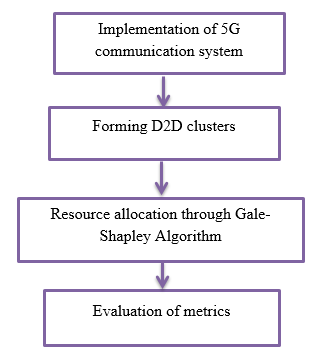
Block Diagram
Specifications
Software: Matlab R2022b
Hardware:
Operating Systems:
• Windows 10
• Windows 7 Service Pack 1
• Windows Server 2019
• Windows Server 2016
Processors:
Minimum: Any Intel or AMD x86-64 processor
Recommended: Any Intel or AMD x86-64 processor with four logical cores and AVX2 instruction set support
Learning Outcomes
· Introduction to Matlab
· What is EISPACK & LINPACK
· How to start with MATLAB
· About Matlab language
· Matlab coding skills
· About tools & libraries
· Application Program Interface in Matlab
· About Matlab desktop
· How to use Matlab editor to create M-Files
· Features of Matlab
· Basics on Matlab
· What is Communication?
· About Communication
· Introduction to Communication
· How Communication Works?
· Importing the System Design, Characterization and Visualization
· Analyzing of BER tool
· Analyzing of Error Rate Test Console
· Generation of WSN
· WSN network creation
· Nodes Communication
· Clustering
· Routing
· Convolutional
· Equalization and Synchronization etc.,
· How to extend our work to another real time applications
· Project development Skills
o Problem analyzing skills
o Problem solving skills
o Creativity and imaginary skills
o Programming skills
o Deployment
o Testing skills
o Debugging skills
o Project presentation skills
o Thesis writing skills
Demo Video


Request for Video
 Paper Publishing
Request Call Back
Would you like to receive a free callback now?
Choose the best time for callback:
Leave your message and we will contact you as soon as possible

6-2-85/B, Old Maternity Hospital Road, Thyagaraja Nagar, Tirupati, Andhra Pradesh – 517501
+91 9030333433
+91 9393939065
0877-2261612

Disclaimer - Takeoff Edu Group Projects are not associated or affiliated with IEEE in any way. The IEEE Projects mentioned here are mentioned in the context of student projects, whose ideas are derived from IEEE publications, not projects of or by IEEE.

