Optimized PI Gain in UPQC Control Based on Improved Zero Attracting Normalized LMS
Objective
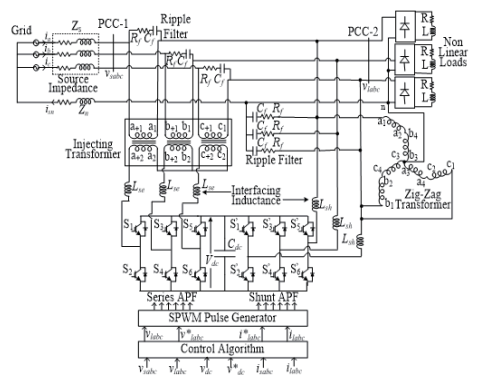
The main objective of the project is developing an enhanced control scheme for a 4-wire Unified Power Quality Conditioner (UPQC) using the Improved Reweighted Zero Attracting Normalized LMS (IRZA-NLMS) algorithm and Self-Adaptive Multi Population Rao (SAMP-Rao) optimization to effectively mitigate power quality issues.
Abstract
This paper presents an Improved Reweighted Zero Attracting Normalized Least Mean Square (IRZA-NLMS) based control scheme is applied in 4-wire Unified Power Quality Conditioner (UPQC) to mitigate current and voltage-based power quality issues. The IRZA-NLMS algorithm has increased efficiency with regard to exploratory rate, steady-state error, and overcoming the drawbacks of NLMS techniques. To raise convergence rate of active signals, the IRZA-NLMS algorithm uses an efficient threshold-based gain function and involvement of zero attracting term is used to determine the inactive signals to their optimum zero stage. In addition to IRZA-NLMS algorithm, a Self-Adaptive Multi Population Rao (SAMP-Rao) optimization is employed to evolve gains of the proportional integral (PI) controller. The SAMP- Rao increases diversity of solution search by splitting total considered population into sub-population groups, each of which searches for the optimal solution in a search space, ensuring that no single individual is trapped in a local minimum and allowing for better exploration and exploitation search. The Integral Time Absolute Error objective function is used to optimize the gains of PI controller of DC and AC link voltage. In laboratory environment, the prescribed method is implemented through Micro-lab box processor with MATLAB interface.
Keywords: Harmonics, Grid, Power Quality, optimization, PI gains, UPQC, voltage sag.
NOTE: Without the concern of our team, please don't submit to the college. This Abstract varies based on student requirements.
Block Diagram
Specifications
Software Configuration:
Operating System : Windows 7/8/10
Application Software: Matlab / Simulink
Hardware Configuration:
RAM : 8 GB
Processor : I3 / I5 (Mostly prefer)
Learning Outcomes
· Introduction to Matlab/Simulink
· How to start with MATLAB
· About Matlab language
· About tools & libraries
· Application of Matlab/Simulink
· Basics on Matlab/Simulink
· Introduction to Microgrid
· SAMP-RAO Controller
· Learned About UPQC
· Learned About Power Quality
· Learned About THD
· Project Development Skills:
o Problem analyzing skills
o Problem solving skills
o Creativity and imaginary skills
o Programming skills
o Deployment
o Testing skills
o Debugging skills
o Project presentation skills
Demo Video


Request for Video
 Paper Publishing
Request Call Back
Would you like to receive a free callback now?
Choose the best time for callback:
Leave your message and we will contact you as soon as possible

6-2-85/B, Old Maternity Hospital Road, Thyagaraja Nagar, Tirupati, Andhra Pradesh – 517501
+91 9030333433
+91 9393939065
0877-2261612

Disclaimer - Takeoff Edu Group Projects are not associated or affiliated with IEEE in any way. The IEEE Projects mentioned here are mentioned in the context of student projects, whose ideas are derived from IEEE publications, not projects of or by IEEE.

