OPTIMIZED LIGHTWEIGHT DUALENCODER FRAMEWORK WITH KNOWLEDGE DISTILLATION FOR REALTIME SKIN LESION SEGMENTATION
Objective
The objective of this project is to develop an optimized lightweight Dual Encoder framework for real-time skin lesion segmentation and multi-class skin disease classification. It integrates U-Net+ and YOLOv8 for segmentation and detection, while a dual encoder combining ResNet50 and EfficientNetB0, along with MobileNet and CNN models, improves classification accuracy. Knowledge distillation ensures efficient, interpretable, and scalable deployment with Grad-CAM visualization.
Abstract
Skin diseases have become a significant health concern globally, affecting millions of individuals across different age groups. Early detection and accurate diagnosis are critical for effective treatment and management of skin disorders. This research focuses on the development of an optimized lightweight DualEncoder framework for skin lesion segmentation and multi-class skin disease classification. The framework leverages advanced machine learning techniques, including U-Net+ for lesion segmentation and YOLOv8 for real-time detection, alongside CNN, MobileNet, and ResNet for the classification of various skin conditions. A dual encoder architecture is employed, combining the strengths of two pre-trained models, ResNet50 and EfficientNetB0, to enhance the accuracy and robustness of the system. The primary goal is to deliver a system that efficiently segments skin lesions and classifies them into categories such as Melanoma, Eczema, BCC (Basal Cell Carcinoma), and others. The system is designed with a user-friendly interface, powered by Flask in the backend and HTML, CSS, and JS for the frontend, ensuring accessibility across platforms. By applying knowledge distillation techniques, the system can perform segmentation and classification tasks with reduced computational cost, making it suitable for deployment in environments with limited resources. To enhance model transparency, Grad-CAM is used to visualize the regions of the skin images that contribute most to the model’s predictions, providing interpretable insights into the decision-making process. The results indicate promising performance in both lesion segmentation and disease classification, achieving high accuracy rates and demonstrating the potential of deep learning-based models in the field of dermatology.
NOTE: Without the concern of our team, please don't submit to the college. This Abstract varies based on student requirements.
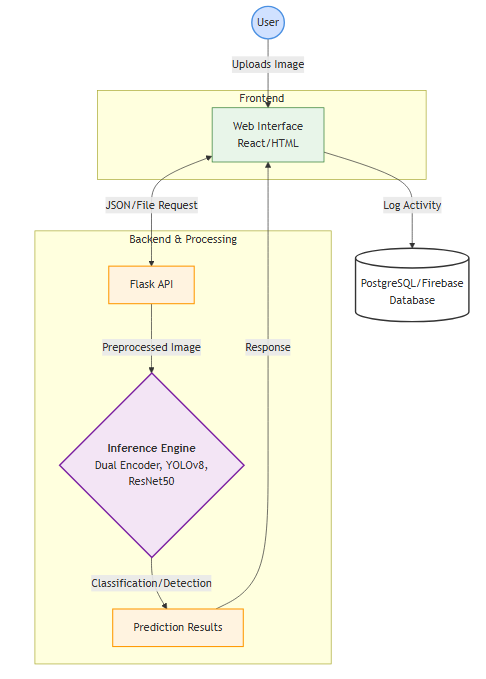
Block Diagram
Specifications
Hardware Requirements
Processor - I3/Intel Processor
Hard Disk - 160GB
Key Board - Standard Windows Keyboard
Mouse - Two or Three Button Mouse
Monitor - SVGA
RAM - 8GB
Software Requirements
• Operating System : Windows 7/8/10
• Programming Language : Python
• Libraries : Pandas, Numpy, scikit-learn.
• IDE/Workbench : Visual Studio Code.


 Paper Publishing

Request Call Back
Would you like to receive a free callback now?
Choose the best time for callback:
Leave your message and we will contact you as soon as possible

6-2-85/B, Old Maternity Hospital Road, Thyagaraja Nagar, Tirupati, Andhra Pradesh – 517501
+91 9030333433
+91 9393939065
0877-2261612

Disclaimer - Takeoff Edu Group Projects are not associated or affiliated with IEEE in any way. The IEEE Projects mentioned here are mentioned in the context of student projects, whose ideas are derived from IEEE publications, not projects of or by IEEE.

