Optimized Brain Tumour Detection: A Dual-Module Approach For MRI Image Enhancement and Tumour Classification
Objective
Develop a deep learning framework for brain tumor detection and segmentation in MRI images using MobileNet and DenseNet architectures.
Abstract
Brain tumor detection and segmentation from MRI images are critical tasks for early diagnosis and effective treatment planning in medical imaging. This project aims to develop an advanced deep learning-based framework for automatic tumor classification and segmentation, leveraging state-of-the-art neural network architectures, namely MobileNet and DenseNet, to improve detection accuracy and computational efficiency. MobileNet's lightweight design facilitates real-time applications by reducing model complexity without sacrificing performance, while DenseNet's densely connected layers enhance feature propagation, leading to more robust and precise classification outcomes.
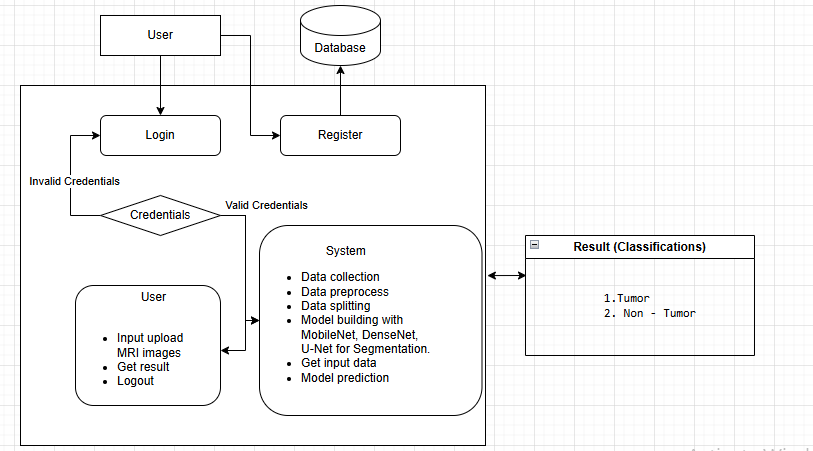
The system is designed to classify brain MRI images into two categories: tumor and non-tumor. The classification networks employ MobileNet and DenseNet to maximize accuracy and optimize computational resources. MobileNet provides a streamlined approach suitable for edge computing and mobile devices, ensuring faster inference times, while DenseNet's improved gradient flow contributes to higher detection accuracy.
For segmentation tasks, the framework can be extended to localize tumor regions within the brain, potentially using complementary segmentation techniques. The integration of these models aims to enhance diagnostic capabilities by providing automated, reliable, and accurate tumor detection to support clinical decision-making. This approach holds promise for improving early diagnosis, reducing the need for invasive diagnostic procedures, and potentially integrating into real-time diagnostic systems in healthcare settings.
The project will evaluate the proposed methods using benchmark datasets, with performance metrics including accuracy, precision, recall, and segmentation quality to validate its effectiveness in real-world medical imaging scenarios.
KEYWORDS: - Brain Tumor, MRI, MobileNet, DenseNet, Deep Learning, Accuracy and Robust.
NOTE: Without the concern of our team, please don't submit to the college. This Abstract varies based on student requirements.
Block Diagram
Specifications
SOFTWARE REQUIREMENS
Operating System : Windows 7/8/10
Server side Script : HTML, CSS, Bootstrap & JS
Programming Language : Python
Libraries :Flask, Torch, Tensorflow, Pandas, Mysql.connector
IDE/Workbench : VSCode
Server Deployment : Xampp Server
Database : MySQL
HARDWARE REQUIREMENTS
Processor - I3/Intel Processor
RAM - 8GB (min)
Hard Disk - 128 GB
Key Board - Standard Windows Keyboard
Mouse - Two or Three Button Mouse
Monitor - Any


 Paper Publishing

Request Call Back
Would you like to receive a free callback now?
Choose the best time for callback:
Leave your message and we will contact you as soon as possible

6-2-85/B, Old Maternity Hospital Road, Thyagaraja Nagar, Tirupati, Andhra Pradesh – 517501
+91 9030333433
+91 9393939065
0877-2261612

Disclaimer - Takeoff Edu Group Projects are not associated or affiliated with IEEE in any way. The IEEE Projects mentioned here are mentioned in the context of student projects, whose ideas are derived from IEEE publications, not projects of or by IEEE.

