Online Fault Tolerant RUL Prediction Strategy for Lithium-Ion Batteries Using Machine Learning
Objective
The objective of this project is to develop an online fault-tolerant Remaining Useful Life (RUL) prediction strategy for lithium-ion batteries using advanced machine learning techniques. The project aims to ensure accurate and real-time estimation of battery health and lifespan, even in the presence of unexpected faults, sensor noise, or missing data. By integrating fault-tolerant mechanisms, the system enhances the reliability and safety of lithium-ion batteries used in critical applications such as electric vehicles, renewable energy storage, and industrial systems. The solution focuses on improving predictive accuracy, reducing downtime, and extending battery life through intelligent, data-driven decision-making.
Abstract
Lithium-ion batteries have become the cornerstone of modern energy storage systems due to their high energy density, long cycle life, and efficiency. However, their performance deteriorates over time due to various operational and environmental stresses, leading to unexpected failures and reduced reliability. Accurate Remaining Useful Life (RUL) prediction is critical to ensure the safety, performance, and cost-effectiveness of such battery systems, particularly in safety-critical applications such as electric vehicles, renewable energy storage, and smart grids. This project presents an online fault-tolerant RUL prediction strategy for lithium-ion batteries using advanced machine learning techniques. The proposed system integrates data preprocessing, model selection, and threshold-based health classification to deliver reliable and interpretable predictions. A user-friendly web application enables real-time prediction by capturing essential battery parameters, including discharge time, voltage variations, charging time, and cycle index. Multiple machine learning models such as Random Forest, Extra Tree Regressor, XGBoost, and Gradient Boosting were evaluated, with the Extra Tree Regressor demonstrating superior performance, achieving near-perfect R² and minimal mean squared error. The system classifies battery health into three categories—Healthy, Warning, and Critical—based on the predicted RUL, enabling proactive maintenance decisions. Furthermore, its fault-tolerant architecture ensures robust operation even under uncertain or noisy data conditions. This research contributes to the development of intelligent battery management systems by improving prediction accuracy, enhancing operational safety, and reducing downtime through timely maintenance interventions.
Keywords
Lithium-ion batteries, Remaining Useful Life (RUL), Machine Learning, Fault Tolerance, Predictive Maintenance, Extra Tree Regressor, Online Prediction, Battery Health Monitoring, Smart Energy Systems, Prognostics.
NOTE: Without the concern of our team, please don't submit to the college. This Abstract varies based on student requirements.
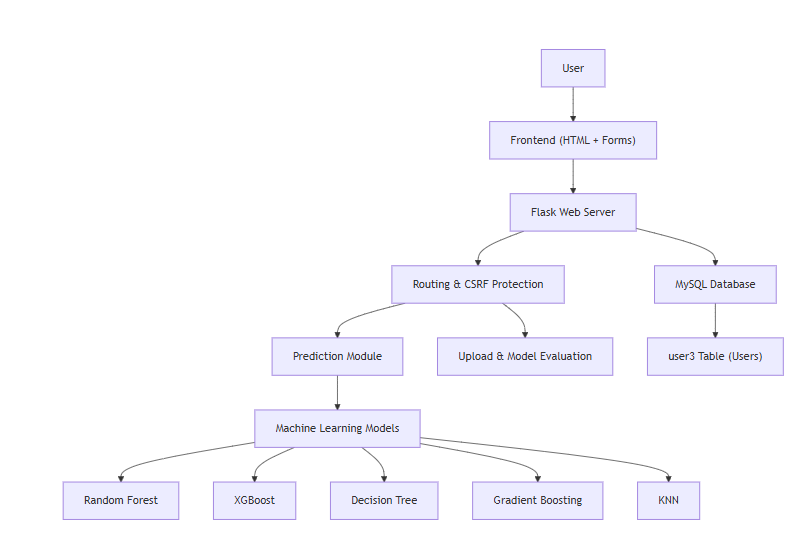
Block Diagram
Specifications
SOFTWARE REQUIREMENS
Operating System : Windows 7/8/10
Server side Script : HTML, CSS, Bootstrap & JS
Programming Language : Python
Libraries Flask, Pandas, Torch, Keras, Sklearn, Numpy , Seaborn
IDE/Workbench : VSCode
Server Deployment : Xampp Server
Database : MySQL
HARDWARE REQUIREMENTS
Processor - I3/Intel Processor
RAM - 8GB (min)
Hard Disk - 128 GB
Key Board - Standard Windows Keyboard
Mouse - Two or Three Button Mouse
Monitor - Any

Demo Video


Request for Video
 Paper Publishing
Request Call Back
Would you like to receive a free callback now?
Choose the best time for callback:
Leave your message and we will contact you as soon as possible

6-2-85/B, Old Maternity Hospital Road, Thyagaraja Nagar, Tirupati, Andhra Pradesh – 517501
+91 9030333433
+91 9393939065
0877-2261612

Disclaimer - Takeoff Edu Group Projects are not associated or affiliated with IEEE in any way. The IEEE Projects mentioned here are mentioned in the context of student projects, whose ideas are derived from IEEE publications, not projects of or by IEEE.

