On the Security of Secure Keyword Search and Data Sharing Mechanism for Cloud Computing
Objective
Assess the security of CPAB-KSDS scheme, identify vulnerabilities, and develop an attack to challenge its IND-CKA security claims.
Abstract
Attribute-Based Proxy Re-Encryption (ABPRE) schemes facilitate secure data sharing based on user attributes without needing a centralized authority for encryption or re-encryption. However, many ABPRE models lack built-in support for efficient keyword search and dynamic keyword updating, often depending on a Private Key Generator (PKG). To overcome this, Ge et al. proposed the CPAB-KSDS scheme, a cipher text-policy ABPRE framework that enables secure keyword searches and keyword updates without PKG involvement. They assert that CPAB-KSDS achieves indistinguishability under chosen-cipher text attacks (IND-CCA) and chosen-keyword attacks (IND-CKA) within the random oracle model.
A detailed security analysis of Ge et al.’s CPAB-KSDS scheme, revealing critical flaws in their security reductions from IND-CKA to underlying assumptions. Additionally, we demonstrate a specific attack that breaches the IND-CKA security of CPAB-KSDS. Our results indicate that CPAB-KSDS fails to achieve the claimed IND-CKA security, exposing significant vulnerabilities in encryption schemes that incorporate keyword search and update features.
Keywords: Cryptanalysis, Attribute-Based Encryption, Proxy Re-Encryption, Searchable Encryption, Keyword Update, Indistinguishability, Security Flaws.
NOTE: Without the concern of our team, please don't submit to the college. This Abstract varies based on student requirements.
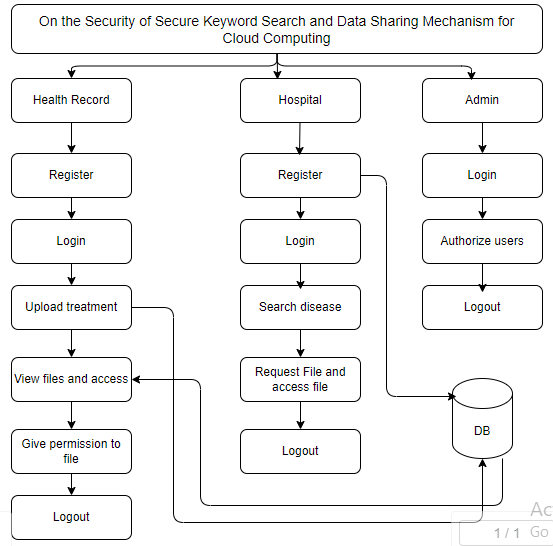
Block Diagram
Specifications
Hardware Requirements
Processor - I3/Intel Processor
Hard Disk - 160GB
Key Board - Standard Windows Keyboard
Mouse - Two or Three Button Mouse
Monitor - SVGA
RAM - 8GB
Software Requirements:
Operating System : Windows 7/8/10
Server side Script : HTML, CSS, Bootstrap & JS
Programming Language : Python
Libraries : Django/Flask
Technology : Python 3.6+
Database : SQLITE/MySql/SQL

Demo Video


Request for Video
 Paper Publishing
Request Call Back
Would you like to receive a free callback now?
Choose the best time for callback:
Leave your message and we will contact you as soon as possible

6-2-85/B, Old Maternity Hospital Road, Thyagaraja Nagar, Tirupati, Andhra Pradesh – 517501
+91 9030333433
+91 9393939065
0877-2261612

Disclaimer - Takeoff Edu Group Projects are not associated or affiliated with IEEE in any way. The IEEE Projects mentioned here are mentioned in the context of student projects, whose ideas are derived from IEEE publications, not projects of or by IEEE.

