On Access Control In Cabin-based Transport Systems Using Raspberry Pi
Abstract
Ensuring secure and authorized access in cabin-based transport systems is essential for enhancing passenger safety and preventing unauthorized usage. This project proposes a smart access control system using Raspberry Pi as the central controller. The system integrates multiple authentication methods including RFID, keypad entry, and fingerprint recognition to ensure multi-level security before granting access. A servo motor is used to control the cabin door mechanism, which activates only upon successful verification. An LCD provides real-time status updates, while a buzzer generates alerts for unauthorized attempts. Additionally, a GSM module is used to send email or SMS notifications for access logs or security breaches. This intelligent and scalable access control framework enhances the security and management of cabin-based transport systems, making it suitable for smart public transport and private vehicle solutions.
NOTE: Without the concern of our team, please don't submit to the college. This Abstract varies based on student requirements.
Block Diagram
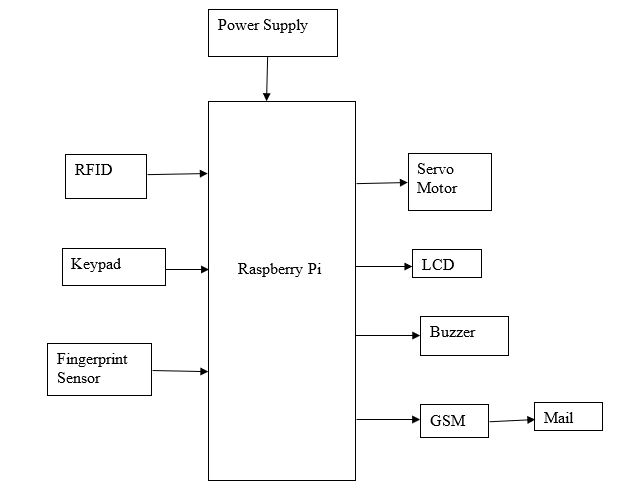
Specifications
Hardware Requirements:
- Raspberry Pi
- RFID Reader and Tags
- Fingerprint Sensor
- Keypad
- Servo Motor
- LCD
- Buzzer
- GSM
Software Requirements:
- Raspbian OS
- Python
Learning Outcomes
- Raspberry Pi pin diagram and architecture
- How to install Raspberry Pi OS and setup environment
- Setting up and installation procedure for Raspberry Pi
- Introduction to Raspberry Pi OS and terminal interface
- Basic coding using Python on Raspberry Pi
- Basics of Embedded Linux systems
- Basics of IoT platforms
- Working of power supply
About Project Development Life Cycle:
- Planning and Requirement Gathering (software, tools, hardware components, etc.)
- Schematic preparation
- Code development and debugging
- Hardware development and debugging
- Development of the project and output testing
Practical exposure to:
- Hardware and software tools
- Solution providing for real-time problems
- Working with team/individual
- Work on creative ideas
Project Development Skills:
- Problem analysing skills
- Problem solving skills
- Creativity and imagination skills
- Programming skills
- Deployment
- Testing skills
- Debugging skills
- Project presentation skills
Thesis writing skills


 Paper Publishing

Request Call Back
Would you like to receive a free callback now?
Choose the best time for callback:
Leave your message and we will contact you as soon as possible

6-2-85/B, Old Maternity Hospital Road, Thyagaraja Nagar, Tirupati, Andhra Pradesh – 517501
+91 9030333433
+91 9393939065
0877-2261612

Disclaimer - Takeoff Edu Group Projects are not associated or affiliated with IEEE in any way. The IEEE Projects mentioned here are mentioned in the context of student projects, whose ideas are derived from IEEE publications, not projects of or by IEEE.

