On Access Control In Cabin-based Transport Systems
Also Available Domains Arduino|IOT|Embedded applications
Abstract
Objective:
The project aims to develop a cost-effective and automated access control system for cabin-based transport using Arduino technology. It authenticates passengers with RFID cards, controls gates via servo motors, and provides real-time audio-visual feedback for secure boarding. Safety features like passenger detection sensors and emergency overrides enhance operational reliability and passenger flow in systems like cable cars and gondolas.
Abstract:
This project presents the development of an automated access control system for
cabin-based transport systems, utilizing Arduino microcontroller technology.
The system employs RFID card readers for passenger authentication, servo motors
to operate entry gates, and sensors to detect passenger presence, ensuring
secure and controlled boarding. Visual and auditory feedback through LEDs, LCD
displays, and buzzers provide real-time status updates to users. The design
includes an emergency stop mechanism for safety and manual override. This
prototype aims to offer an affordable, efficient, and reliable solution to
manage access in cable cars, gondolas, and similar transport systems, enhancing
security and operational efficiency.
Keywords: Arduino, access control, RFID, cabin-based transport, servo motor, passenger authentication, sensors, automated gate, security system, emergency stop
NOTE: Without the concern of our team, please don't submit to the college. This Abstract varies based on student requirements.
Block Diagram
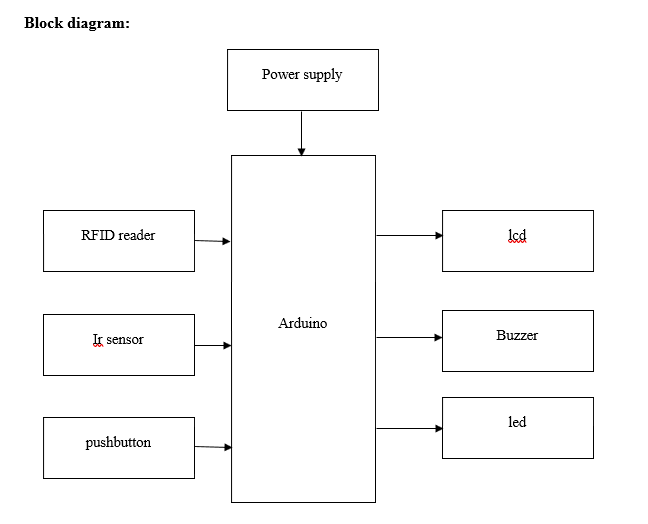
Specifications
Hardware components:
- Arduino
- Lcd
- Ir sensor
- Rfid reader
- Rfid cards
- Gsm
- Pushbutton
- Buzzer
- Leds
- Power supply
Software Requirements
- Arduino idle
- Embedded c
Learning Outcomes
Learning Outcomes
- Understanding Arduino pin diagram and architecture
- Installing and configuring Arduino IDE for Arduino
- Setting up Arduino for multi-sensor health monitoring
- Basic coding with Arduino for healthcare applications
- Working with ir sensor sensors
- Interfacing I2C LCD with Arduino for real-time display
- Interfacing RFID readers with Arduino
- Interfacing pushbutton with Arduino
- Interfacing buzzer with Arduino
- Understanding power supply requirements for wearable devices
About Project Development Life Cycle:
- Planning and Requirement Gathering (software, tools, hardware components, etc.)
- Schematic preparation
- Code development and debugging
- Hardware setup and debugging
- Development of the Project and Output testing
Practical exposure to:
- Hardware and software tools
- Solution providing for real-time problems
- Working with a team/individually
- Working on creative ideas
Project development skills:
- Problem analysis
- Problem solving
- Creativity and imagination
- Programming skills (Python)
- Deployment
- Testing
- Debugging
- Project presentation
- Report writing


 Paper Publishing

Request Call Back
Would you like to receive a free callback now?
Choose the best time for callback:
Leave your message and we will contact you as soon as possible

6-2-85/B, Old Maternity Hospital Road, Thyagaraja Nagar, Tirupati, Andhra Pradesh – 517501
+91 9030333433
+91 9393939065
0877-2261612

Disclaimer - Takeoff Edu Group Projects are not associated or affiliated with IEEE in any way. The IEEE Projects mentioned here are mentioned in the context of student projects, whose ideas are derived from IEEE publications, not projects of or by IEEE.

