OEF-LULC: An Optimized and Explainable AI-Based Framework for Land Use Land Cover Classification
Objective
The primary objective of this project is to develop an optimized and explainable framework for accurate Land Use Land Cover classification using satellite imagery. The project aims to design advanced deep learning architectures capable of extracting meaningful spatial, spectral, and contextual features from remote sensing images. One important objective is to implement the STATEnhancedViT model that combines dynamic band embedding, patch-level positional encoding, temporal cross-attention, hybrid residual-transformer blocks, and auxiliary classifiers for enhanced feature learning. Another objective is to develop the RSC-DAN model using residual learning and dual attention mechanisms to improve important feature representation and suppress irrelevant information. The project also aims to improve classification accuracy across multiple land cover categories through effective attention-based learning strategies. Another objective is to integrate GradCAM-based explainability for visualizing image regions influencing prediction behavior and improving model transparency. The system further aims to provide a user-friendly Flask-based web interface for image upload and classification tasks. Performance evaluation using suitable metrics is also considered an important objective to measure the effectiveness and robustness of the proposed framework for LULC classification.
Abstract
Land Use Land Cover (LULC) classification is an important task in satellite image analysis for environmental monitoring, agricultural observation, urban expansion analysis, and resource management. Traditional machine learning and deep learning approaches often face difficulties in extracting complex spatial, spectral, and contextual information from remote sensing images. To address these limitations, this work presents OEF-LULC: An Optimized and Explainable AI-Based Framework for Land Use Land Cover Classification using advanced transformer and attention-based deep learning architectures. The framework utilizes two proposed models, namely STATEnhancedViT (Spectral-Temporal Attention Transformer – Enhanced Version) and RSC-DAN (Residual Spatial-Channel Dual Attention Network), for accurate multi-class classification of satellite imagery. The dataset includes ten land cover categories such as AnnualCrop, Forest, Highway, Industrial, Residential, River, and SeaLake. STATEnhancedViT combines dynamic band embedding, patch-level positional encoding, temporal cross-attention, hybrid residual-transformer blocks, and auxiliary classifiers to improve feature representation and contextual understanding. RSC-DAN integrates residual learning with spatial and channel dual attention mechanisms to strengthen important image features while suppressing irrelevant information. The framework also incorporates GradCAM-based explainability to visualize important regions influencing classification decisions. The system is implemented using Python and Flask with an interactive web interface for image classification. Experimental analysis demonstrates that the proposed framework improves feature learning, classification accuracy, and interpretability for LULC classification tasks.
Keywords: Land Use Land Cover, Satellite Image Classification, Explainable AI, Vision Transformer, GradCAM, Dual Attention Network, Remote Sensing, Spatial Attention, Temporal Attention, Deep Learning
NOTE: Without the concern of our team, please don't submit to the college. This Abstract varies based on student requirements.
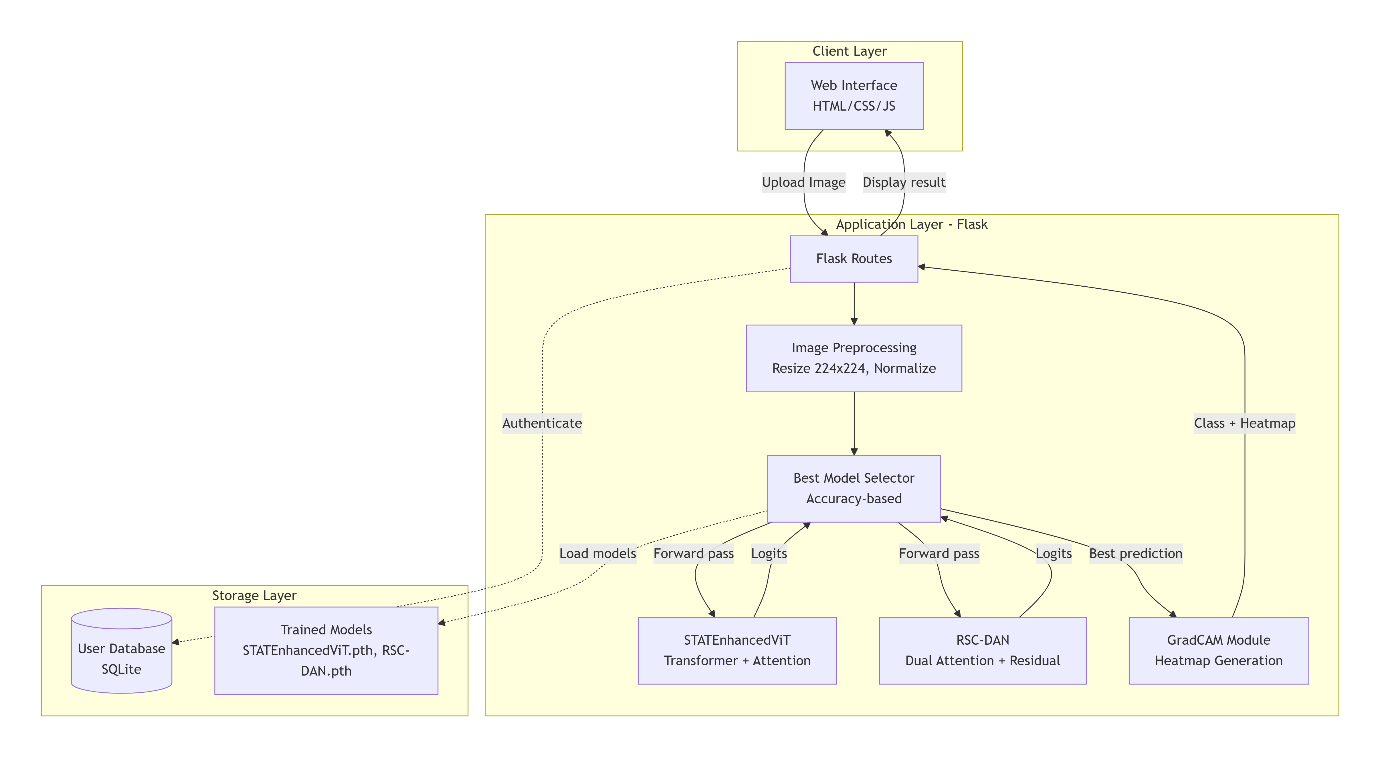
Block Diagram
Specifications
5.2 Hardware Requirements
• Processor - I5/Intel Processor
• RAM - 8GB (min)
• Hard Disk - 160 GB
• Key Board - Standard Windows Keyboard
• Mouse - Two or Three Button Mouse
• Monitor - Any
5.3 Software Requirements
• Operating System : Windows 7/8/10
• Server side Script : HTML, CSS, Bootstrap & JS
• Programming Language : Python
• Libraries : Flask, Pandas, Numpy, Mysql.connector, Os,
• IDE/Workbench : VS-Code
• Technology : Python 3.10+
• Server Deployment : Xampp Server
• Database : MySQL


 Paper Publishing

Request Call Back
Would you like to receive a free callback now?
Choose the best time for callback:
Leave your message and we will contact you as soon as possible

6-2-85/B, Old Maternity Hospital Road, Thyagaraja Nagar, Tirupati, Andhra Pradesh – 517501
+91 9030333433
+91 9393939065
0877-2261612

Disclaimer - Takeoff Edu Group Projects are not associated or affiliated with IEEE in any way. The IEEE Projects mentioned here are mentioned in the context of student projects, whose ideas are derived from IEEE publications, not projects of or by IEEE.

