Ocean Wave Height Prediction

Project Code :TCMIPY49

Objective

The objective of this study is to predict significant wave height (Hs) using time-series data from the Mooloolaba measuring buoy. It aims to implement and evaluate the performance of LSTM and ARIMA models for wave height prediction. The study will compare the accuracy and ability of both models to capture temporal relationships, trends, and seasonality in the dataset. Ultimately, the goal is to enhance the accuracy of ocean wave forecasting for marine applications through the use of advanced machine learning models.

Abstract

This study aims to predict significant wave height (Hs) using wave measurement data collected from the Mooloolaba measuring buoy. The dataset includes several dependent variables such as Date/Time, Sea Surface Temperature (SST), Hs, Hmax, Tz, Tp, and Peak Direction, with Hs being the primary variable of interest for prediction. Both Long Short-Term Memory (LSTM) and AutoRegressive Integrated Moving Average (ARIMA) models were utilized for forecasting ocean wave heights. LSTM was chosen due to its ability to capture temporal relationships in time series data, making it well-suited for predicting wave heights over time. On the other hand, ARIMA was more suitable for identifying trends and seasonality in the dataset, helping to capture cyclic patterns that influence wave heights. The study aims to evaluate and compare the performance of these algorithms, providing insights into their respective strengths in ocean wave height forecasting. By analyzing the prediction accuracy and model performance, the study seeks to determine the most effective method for improving forecasts. These predictions have significant applications in marine safety, navigation, and research, contributing to better decision-making and risk management in ocean-related activities. Furthermore, the results could serve as a foundation for future advancements in real-time ocean wave height forecasting, ensuring more accurate and timely predictions for marine operations. Keywords: Significant Wave Height, Mooloolaba Measuring Buoy, Sea Surface Temperature (SST), Long Short-Term Memory (LSTM), AutoRegressive Integrated Moving Average (ARIMA), Time Series Forecasting, Ocean Wave Height, Marine Safety, Navigation, Research, Trend Analysis, Seasonality, Temporal Relationships, Wave Prediction Models.

NOTE: Without the concern of our team, please don't submit to the college. This Abstract varies based on student requirements.

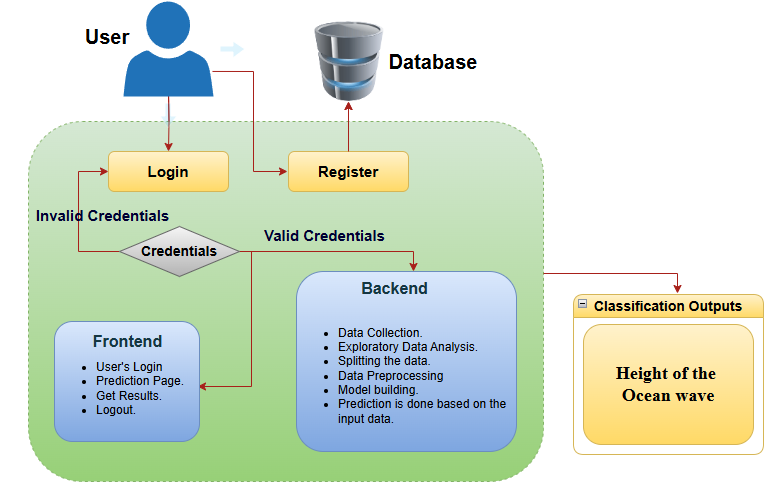
Block Diagram
Specifications

 Hardware Requirement

 Processor                                 - I3/Intel Processor

Hard Disk                                - 160GB

Key Board                               - Standard Windows Keyboard

Mouse                                     - Two or Three Button Mouse

Monitor                                   - SVGA

RAM                                       - 8GB 

Software Requirements

β€’      Operating System                    :  Windows 7/8/10

β€’      Programming Language         :  Python

β€’      Libraries                                  :  Pandas, Numpy, scikit-learn

.β€’      IDE/Workbench                      :  Visual Studio Code. 

Demo Video

mail-banner
call-banner
contact-banner
Request Video




