Novel Sentiment Majority Voting Classifier and Transfer Learning-Based Feature Engineering for Sentiment Analysis of Deepfake Tweets
Objective
The objective of this study is to develop a sentiment majority voting classifier for deepfake tweets using transfer learning-based feature engineering, specifically by leveraging a pre-trained BERT model and Random Forest classifier. Additionally, the research aims to evaluate the model's performance through metrics such as Accuracy, Precision, Recall, and F1-Score while identifying key features that influence classification.
Abstract
This research presents a novel approach to sentiment analysis of deepfake tweets by developing a sentiment majority voting classifier combined with transfer learning-based feature engineering. The objective is to accurately distinguish between human-generated and robot-generated tweets, leveraging the power of machine learning and natural language processing. A two-column dataset containing the tweet text and corresponding labels (human or robot) serves as the input. We employ Bidirectional Encoder Representations from Transformers (BERT) for feature extraction, taking advantage of its superior contextual understanding of text. These features are then classified using a Random Forest algorithm, known for its robustness and effectiveness in handling large datasets. The proposed model integrates the strengths of both BERT and Random Forest, providing an efficient and scalable solution for deepfake tweet detection. This approach contributes to enhanced detection accuracy, offering a practical framework for identifying automated content in social media environments.
Keywords: BERT and Random Forest, Kaggle dataset.
NOTE: Without the concern of our team, please don't submit to the college. This Abstract varies based on student requirements.
Block Diagram
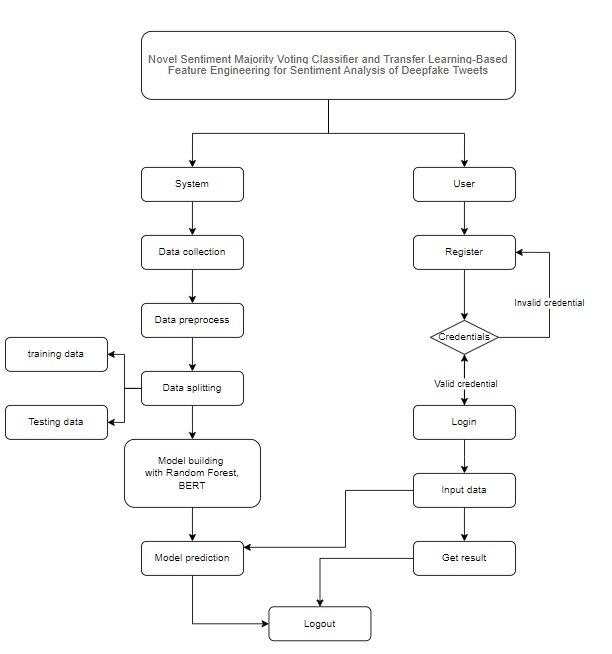
Specifications
Hardware:
Operating system : Windows 7 or 7+
RAM : 8 GB
Hard disc or SSD : More than 500 GB
Processor : Intel 3rd generation or high or Ryzen with 8 GB Ram
Software:
Software’s : Python 3.10 or high version
IDE : Visual Studio Code.
Framework : Flask


 Paper Publishing

Request Call Back
Would you like to receive a free callback now?
Choose the best time for callback:
Leave your message and we will contact you as soon as possible

6-2-85/B, Old Maternity Hospital Road, Thyagaraja Nagar, Tirupati, Andhra Pradesh – 517501
+91 9030333433
+91 9393939065
0877-2261612

Disclaimer - Takeoff Edu Group Projects are not associated or affiliated with IEEE in any way. The IEEE Projects mentioned here are mentioned in the context of student projects, whose ideas are derived from IEEE publications, not projects of or by IEEE.

