Noise Modulation of a Bandgap Reference by Using a Single Resistor
Objective
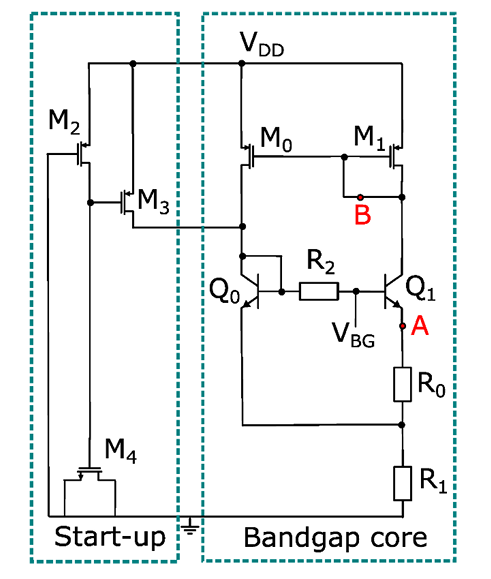
This paper presents a low-noise CMOS bandgap reference employing a single-resistor noise modulation technique to improve reference voltage stability and reduce output noise. The proposed architecture utilizes a carefully optimized resistor in the bandgap reference network to modulate and suppress thermal and flicker noise without significantly increasing circuit complexity or power consumption.
Abstract
This paper presents a low-noise CMOS bandgap reference employing a single-resistor noise modulation technique to improve reference voltage stability and reduce output noise. The proposed architecture utilizes a carefully optimized resistor in the bandgap reference network to modulate and suppress thermal and flicker noise without significantly increasing circuit complexity or power consumption. By minimizing noise contributions from the bias circuitry and improving current distribution, the circuit achieves a stable reference voltage with enhanced line regulation, load regulation, and temperature stability. The design is implemented and simulated using CMOS technology in Cadence Virtuoso, where key performance parameters including reference voltage accuracy, output noise, power consumption, supply current, temperature coefficient, line regulation, and load regulation are evaluated. The proposed design demonstrates lower output noise, improved voltage stability, and enhanced energy efficiency compared with conventional CMOS bandgap reference circuits, making it suitable for precision analog, mixed-signal, and power management applications.
NOTE: Without the concern of our team, please don't submit to the college. This Abstract varies based on student requirements.
Block Diagram

Learning Outcomes
· Understand the operating principle of CMOS bandgap reference circuits.
· Study PTAT and CTAT voltage generation mechanisms.
· Analyze the single-resistor noise modulation technique.
· Evaluate reference voltage accuracy.
· Measure output noise performance.
· Analyze temperature coefficient.
· Measure power consumption and supply current.
· Evaluate line regulation and load regulation.
· Study the effects of process, voltage, and temperature (PVT) variations.
· Compare conventional and proposed bandgap reference architectures.
· Evaluate MOS transistor count and circuit complexity.


 Paper Publishing

Request Call Back
Would you like to receive a free callback now?
Choose the best time for callback:
Leave your message and we will contact you as soon as possible

6-2-85/B, Old Maternity Hospital Road, Thyagaraja Nagar, Tirupati, Andhra Pradesh – 517501
+91 9030333433
+91 9393939065
0877-2261612

Disclaimer - Takeoff Edu Group Projects are not associated or affiliated with IEEE in any way. The IEEE Projects mentioned here are mentioned in the context of student projects, whose ideas are derived from IEEE publications, not projects of or by IEEE.

