New SEPIC Derived Semi-Bridgeless PFC Converter for Battery Charging Application
Also Available Domains DC - DC Converters
Objective
The main objective of this project is to develop a novel AC–DC semi-bridgeless dual-switch SEPIC converter tailored for battery-charging applications that inherently corrects power factor to unity and minimizes total harmonic distortion in the input current.
Abstract
This paper proposes a novel AC–DC semi-bridgeless dual-switch SEPIC converter tailored for battery charging applications. The proposed design enhances power factor (PF) and significantly reduces total harmonic distortion (THD) in the AC input current by introducing a modified converter topology. Operating in discontinuous conduction mode (DCM), the converter achieves low current THD while enabling a reduction in inductor size. The topology utilizes two power switches to perform power factor correction (PFC), eliminating the need for an additional closed-loop control algorithm. A key innovation lies in the strategic selection and design of the circuit structure, which ensures near-unity power factor and low THD based on the energy balancing of inductors and capacitors. Moreover, the integration of blocking diodes effectively prevents circulating currents through the input inductor, thereby enhancing overall efficiency. This compact and efficient converter offers a promising solution for high-performance battery charging systems.
Keywords: Ac-dc power conversion, SEPIC, power factor correction, total harmonic distortion, discontinuous conduction mode, energy storage system.
NOTE: Without the concern of our team, please don't submit to the college. This Abstract varies based on student requirements.
Block Diagram
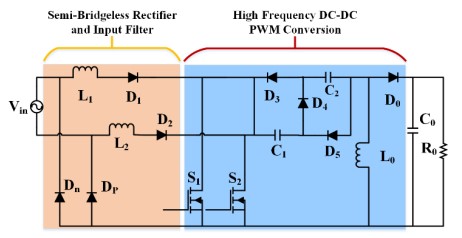
Specifications
Software Configuration:
Operating System : Windows 7/8/10
Application Software: Matlab/Simulink
Hardware Configuration:
RAM : 8 GB
Processor : I3 / I5 (Mostly prefer)Learning Outcomes
· Introduction to Matlab/Simulink
· What is EISPACK & LINPACK
· How to start with MATLAB
· About Matlab language
· About tools & libraries
· Application of Matlab/Simulink
· About Matlab desktop
· Features of Matlab/Simulink
· Basics on Matlab/Simulink
· We can learn about grid
· We can learn about Converters (AC-DC)
· We can learn about Switches
· We can learn about THD
· We can learn about battery
· Project Development Skills:
o Problem analyzing skills
o Problem solving skills
o Creativity and imaginary skills
o Programming skills
o Deployment
o Testing skills
o Debugging skills
o Project presentation skills
Demo Video


Request for Video
Related Projects
 Paper Publishing
Request Call Back
Would you like to receive a free callback now?
Choose the best time for callback:
Leave your message and we will contact you as soon as possible

6-2-85/B, Old Maternity Hospital Road, Thyagaraja Nagar, Tirupati, Andhra Pradesh – 517501
+91 9030333433
+91 9393939065
0877-2261612

Disclaimer - Takeoff Edu Group Projects are not associated or affiliated with IEEE in any way. The IEEE Projects mentioned here are mentioned in the context of student projects, whose ideas are derived from IEEE publications, not projects of or by IEEE.

