Multimodal Emotion Classification using Machine Learning and Deep Learning
Objective
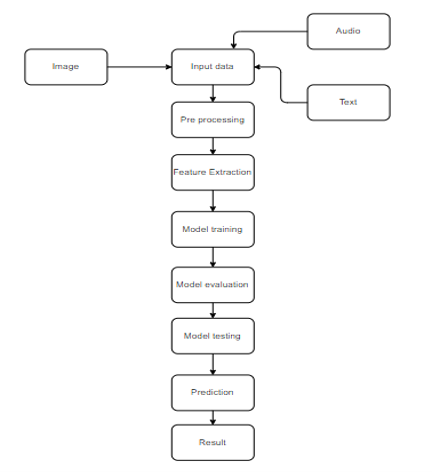
The objective of the project is to develop a comprehensive multimodal emotion classification system utilizing machine learning and deep learning techniques. This system aims to accurately recognize and interpret human emotions across diverse modalities, including speech, text, and facial expressions. By integrating information from these modalities, the project seeks to create a robust framework capable of discerning nuanced emotional cues in various communication channels. Specific goals include implementing speech processing algorithms for emotion recognition from audio signals, employing machine learning, algorithms for text-based emotion classification, and utilizing deep learning techniques for facial expression analysis.
Abstract
This project presents a novel approach to multimodal emotion classification, combining speech processing, text analysis, and image-based detection to recognize human emotions accurately. It employs advanced machine learning and deep learning techniques to interpret emotions across different communication modalities. For speech emotion recognition, it extracts features like Mel-frequency cepstral coefficients (MFCC) and uses them in a Deep Neural Network (DNN) for effective emotion classification. In the realm of text, it utilizes algorithms such as Long Short-Term Memory (LSTM) to decipher emotions from written communication, leveraging the rich emotional context embedded in text. The project also explores emotion detection from facial expressions, employing Convolutional Neural Networks (CNNs) enhanced with wavelet transform techniques to improve accuracy in classifying emotions based on facial cues. This integrated system demonstrates significant potential in enhancing human-machine interactions by providing a more nuanced understanding of human emotions through diverse communication channels. By addressing challenges in feature extraction, data fusion, and model scalability, this research advances the field of emotion recognition and opens new avenues for applications in affective computing, mental health, and beyond.
KEYWORDS: Emotion Recognition, Speech Processing, Convolutional Neural Networks (CNN), Long Short-Term Memory (LSTM), Mel-frequency cepstral coefficients (MFCC), Chromogram, Human-Computer Interaction, Mental Health Support, Customer Service Analytics, Feature Extraction, Model Evaluation, Real-Time Implementation, User Interface Development, Human Emotions, Speech Pattern Variations, Real-Time Processing.
NOTE: Without the concern of our team, please don't submit to the college. This Abstract varies based on student requirements.
Block Diagram
Specifications
H/W Specifications:
Processor : I5/Intel Processor
RAM : 8GB (min)
Hard Disk : 128 GB
S/W Specifications:
Operating System : Windows 10
Server-side Script : Python 3.6
IDE : PyCharm, Jupyter notebook
Libraries Used : Numpy, IO, OS, Flask, Keras, pandas, tensorflow

Demo Video


Request for Video
 Paper Publishing
Request Call Back
Would you like to receive a free callback now?
Choose the best time for callback:
Leave your message and we will contact you as soon as possible

6-2-85/B, Old Maternity Hospital Road, Thyagaraja Nagar, Tirupati, Andhra Pradesh – 517501
+91 9030333433
+91 9393939065
0877-2261612

Disclaimer - Takeoff Edu Group Projects are not associated or affiliated with IEEE in any way. The IEEE Projects mentioned here are mentioned in the context of student projects, whose ideas are derived from IEEE publications, not projects of or by IEEE.

