Multimodal Deep LearningBased onBrain Stroke Detection Using Imaging and LifestyleData
Objective
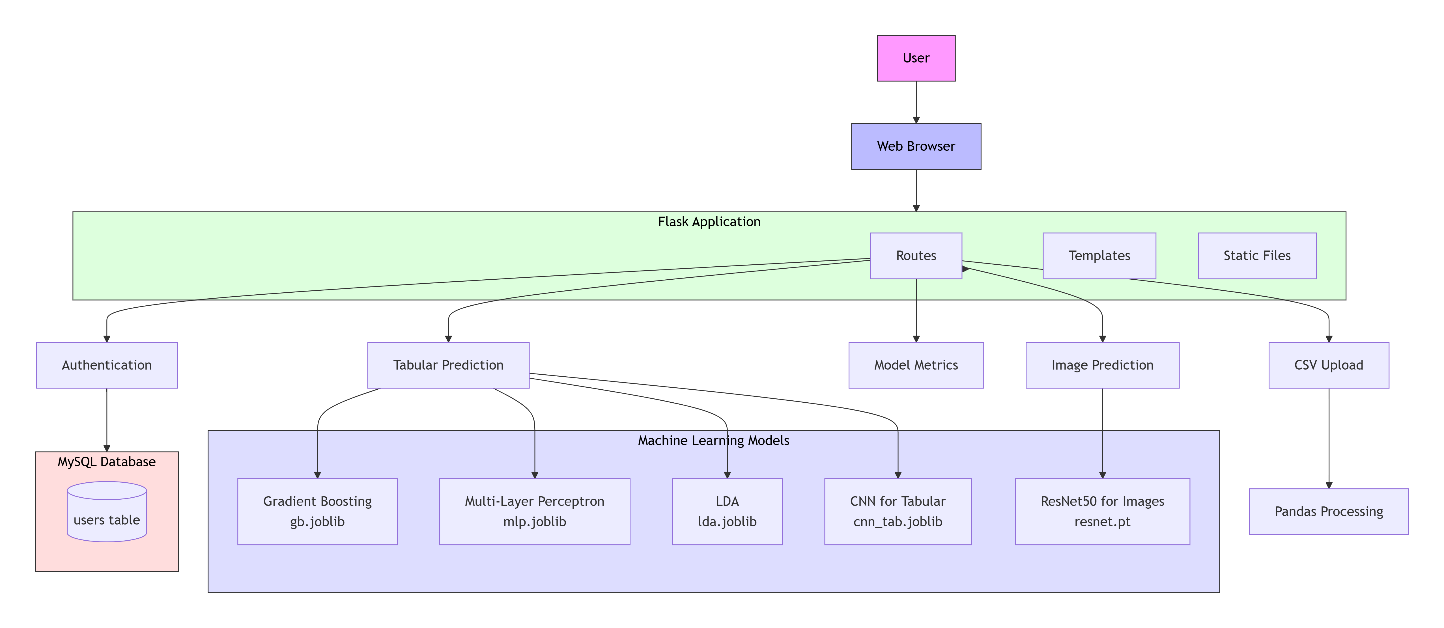
The primary objective of this project is to develop an intelligent and deployable system for brain stroke detection that integrates deep learning, image classification, and lifestyle data analysis. The system aims to implement a robust prediction model using multiple advanced techniques, including Convolutional Neural Networks (CNN), Multi-Layer Perceptrons (MLP), Linear Discriminant Analysis (LDA), ResNet50, and Gradient Boosting. A Flask-based web interface will be developed to facilitate user interaction, enabling features such as file upload, prediction, and model selection. By combining lifestyle data and medical imaging, the system seeks to provide a comprehensive stroke risk prediction. To ensure data security, user information and prediction logs will be stored securely in a MySQL database. Additionally, the project focuses on minimizing false positives and achieving high accuracy for real-time stroke predictions, aiming for effective and reliable outcomes in clinical settings.
Abstract
The project titled "Multimodal Deep Learning-Based Brain Stroke Detection Using Imaging and Lifestyle Data" aims to develop a web-based application for the early detection of brain strokes using a combination of medical imaging (ResNet50-based image classification) and lifestyle factors (including age, gender, hypertension, heart disease, smoking status, and glucose levels). The system utilizes both clinical and imaging data to make more accurate predictions, offering a robust method for identifying individuals at high risk of a stroke. The application features user authentication, file upload, model training, and image prediction capabilities. It allows users to upload both CSV datasets (containing lifestyle data) and medical images (such as X-rays or CT scans). Machine learning models, including Linear Discriminant Analysis (LDA), Gradient Boosting, Multi-Layer Perceptron (MLP), and Convolutional Neural Networks (CNN), are employed for prediction. The system offers a real-time prediction route for users to assess their stroke risk based on personal data, providing personalized health recommendations. Additionally, the image classification aspect of the project incorporates the ResNet model, trained to classify medical images into categories of stroke detection, offering insights based on the visual assessment of medical scans.
Keywords: Brain Stroke Detection, Multimodal Deep Learning, Imaging Data, Lifestyle Data, Machine Learning, ResNet, CSV Upload, Gradient Boosting, Linear Discriminant Analysis, Prediction System, Flask Web Application.
NOTE: Without the concern of our team, please don't submit to the college. This Abstract varies based on student requirements.
Block Diagram
Specifications
SOFTWARE REQUIREMENS
Operating System : Windows 7/8/10
Server side Script : Flask
Programming Language : Python
Libraries : Flask, Tensorflow, Pandas, Torch, Keras, Sklearn, Numpy , Seaborn
IDE/Workbench : VSCode
Server Deployment : Xampp Server
Database : mysql
HARDWARE REQUIREMENTS
Processor - I3/Intel Processor
RAM - 8GB (min)
Hard Disk - 128 GB
Key Board - Standard Windows Keyboard
Mouse - Two or Three Button Mouse
Monitor - Any


 Paper Publishing

Request Call Back
Would you like to receive a free callback now?
Choose the best time for callback:
Leave your message and we will contact you as soon as possible

6-2-85/B, Old Maternity Hospital Road, Thyagaraja Nagar, Tirupati, Andhra Pradesh – 517501
+91 9030333433
+91 9393939065
0877-2261612

Disclaimer - Takeoff Edu Group Projects are not associated or affiliated with IEEE in any way. The IEEE Projects mentioned here are mentioned in the context of student projects, whose ideas are derived from IEEE publications, not projects of or by IEEE.

