Multi Pathway 3D CNN Wit Conditional Random Field for Automated Segmentation of Multiple Sclerosis Lesions in MRI
Objective
The primary objective of this project is to develop an automated, accurate, and accessible deep learning-based framework for segmenting Multiple Sclerosis (MS) lesions in brain MRI scans. The system aims Design and implement a Multi-Pathway 3D CNN that captures both fine-grained and contextual information from volumetric MRI data.
Abstract
This project presents a robust automated framework for the segmentation of Multiple Sclerosis (MS) lesions in brain MRI scans, combining the strengths of deep learning and probabilistic graphical models. We introduce a multi-pathway 3D Convolutional Neural Network (3D CNN) architecture, which captures both local and global contextual information through multiple receptive fields. To further enhance boundary refinement and reduce false positives, a Conditional Random Field (CRF) is applied as a post-processing step. Additionally, comparative evaluations are performed using U-Net++ and Swin Transformer-based segmentation models to benchmark performance across different deep learning paradigms. The web-based system is developed using Flask, integrated with a responsive frontend using HTML and CSS for user-friendly lesion visualization and interaction. Our pipeline demonstrates improved lesion detection accuracy and spatial consistency, making it suitable for clinical decision support in neuroimaging diagnostics.
Keywords:
3D CNN, U-Net++, Swin Transformer, Multiple Sclerosis, MRI Segmentation,
Conditional Random Field, Flask, Deep Learning, Neuroimaging, Automated Lesion
Detection.
NOTE: Without the concern of our team, please don't submit to the college. This Abstract varies based on student requirements.
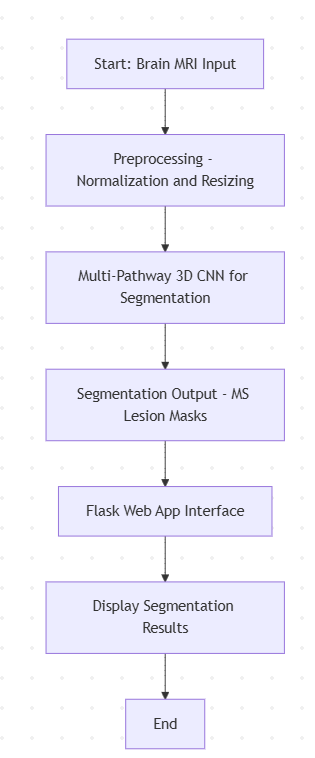
Block Diagram
Specifications
H/W CONFIGURATION:
u Processor - I3/Intel Processor
u Hard Disk -160 GB
u RAM - 8 GB
S/W CONFIGURATION:
u Operating System : Windows 7/8/10 .
u Server-side Script : HTML, CSS & JS.
u IDE : Vscode
u Libraries Used : Numpy, Pandas,Sklearn,Tensorflow
u Franework : Flask
u Technology : Python 3.6+.


 Paper Publishing

Request Call Back
Would you like to receive a free callback now?
Choose the best time for callback:
Leave your message and we will contact you as soon as possible

6-2-85/B, Old Maternity Hospital Road, Thyagaraja Nagar, Tirupati, Andhra Pradesh – 517501
+91 9030333433
+91 9393939065
0877-2261612

Disclaimer - Takeoff Edu Group Projects are not associated or affiliated with IEEE in any way. The IEEE Projects mentioned here are mentioned in the context of student projects, whose ideas are derived from IEEE publications, not projects of or by IEEE.

