MTGA-Net A Multi-Tier Global-Attention Deep Learning Framework for Enhanced Breast Mass Classification in Mammographic Images
Objective
The objective of this study is to develop a novel deep learning framework, MTGA-Net, for accurate classification of breast masses in mammographic images. It specifically aims to integrate the newly proposed HiRes-GANet and Mammo-MLA models, which leverage hierarchical residual blocks and multi-resolution attention mechanisms to capture both fine-grained and global lesion features. The study seeks to enhance diagnostic precision and robustness compared to conventional approaches. It also focuses on providing interpretability through Grad-CAM visualizations, enabling clinicians to understand model decisions. Ultimately, the objective is to support radiologists in early and reliable breast cancer detection, reducing misclassification and improving patient outcomes.
Abstract
Accurate and early detection of breast masses in mammographic images is critical for effective diagnosis and treatment of breast cancer. This study presents MTGA-Net, a multi-tier global-attention deep learning framework designed to enhance the classification of breast masses as benign or malignant. The framework integrates two specialized models: HiRes-GANet (Hierarchical Residual–Global Attention Network) and Mammo-MLA (Mammogram Multi-resolution Lightweight Attention), both optimized to capture fine-grained and global features across multiple resolutions. HiRes-GANet employs hierarchical residual blocks combined with global attention mechanisms to emphasize diagnostically significant regions while maintaining deep feature representations. Mammo-MLA is a lightweight network that uses multi-resolution attention gates to efficiently extract informative features and combine coarse and fine details, providing a balance between accuracy and computational efficiency. The framework is trained and evaluated on the publicly available Breast Cancer Mammographic Dataset from Kaggle, comprising annotated mammograms with varying lesion sizes and appearances. Grad-CAM visualization is incorporated to provide interpretability, highlighting regions contributing to model predictions and enabling better clinical insight. Experimental results demonstrate that MTGA-Net improves classification performance and robustness compared to conventional approaches, while Grad-CAM facilitates understanding of model decisions. This framework can support radiologists in enhancing diagnostic accuracy and reducing misclassification, particularly in cases with subtle or complex mass patterns. Future work includes extending the approach to multi-view mammograms and other lesion types, as well as optimizing for deployment in clinical settings with limited computational resources.
Keywords: Breast mass classification, Mammography, Deep learning, Global attention, HiRes-GANet, Mammo-MLA, Grad-CAM, Multi-resolution feature extraction.
NOTE: Without the concern of our team, please don't submit to the college. This Abstract varies based on student requirements.
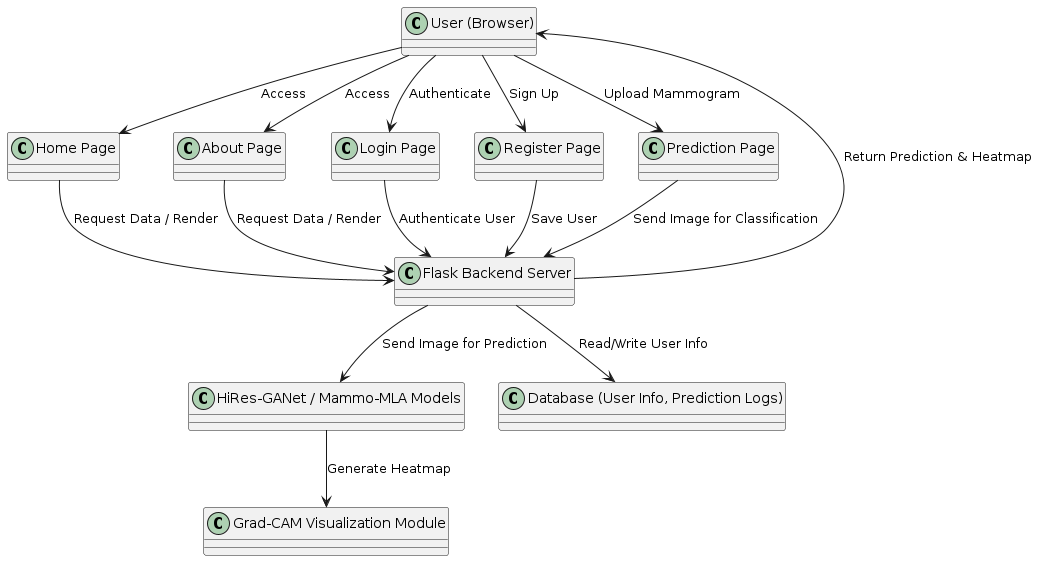
Block Diagram
Specifications
SOFTWARE REQUIREMENS
Operating System : Windows 7/8/10
Server side Script : HTML, CSS & JS
Programming Language : Python
Libraries : PyTorch — NumPy — Pandas — Matplotlib — OpenCV — scikit-learn — Torchvision — PIL — Seaborn.
IDE/Workbench : VSCode
Server Deployment : MYSQL
Database : MySQL
HARDWARE REQUIREMENTS
Processor - I3/Intel Processor
RAM - 8GB (min)
Hard Disk - 128 GB
Key Board - Standard Windows Keyboard
Mouse - Two or Three Button Mouse
Monitor - Any


 Paper Publishing

Request Call Back
Would you like to receive a free callback now?
Choose the best time for callback:
Leave your message and we will contact you as soon as possible

6-2-85/B, Old Maternity Hospital Road, Thyagaraja Nagar, Tirupati, Andhra Pradesh – 517501
+91 9030333433
+91 9393939065
0877-2261612

Disclaimer - Takeoff Edu Group Projects are not associated or affiliated with IEEE in any way. The IEEE Projects mentioned here are mentioned in the context of student projects, whose ideas are derived from IEEE publications, not projects of or by IEEE.

