MSMD-YOLO Enhanced Printed Circuit Board Defect Detection With a Multi-Scale Merging and Attention Network
Objective
The main objective of this project is to develop an advanced system for accurately identifying defects in printed circuit boards. It aims to enhance the YOLO architecture to improve detection of small and intricate PCB faults. The system focuses on six common defect types, including short circuits, spurs, missing holes, mouse bites, open circuits, and spurious copper. It seeks to provide high precision and speed in defect recognition to support manufacturing quality control. Additionally, the project integrates a user-friendly interface for easy image input and defect visualization.
Abstract
This project presents the development of YoloDefectNET, a deep learning-based model for the detection of defects in printed circuit boards (PCBs). With the rapid advancement of industrial automation, PCB defect detection has become critical to ensuring high product quality. The YoloDefectNET model is designed to enhance the traditional YOLO architecture by integrating multi-scale merging and attention mechanisms. These enhancements allow for more accurate and efficient detection of tiny and complex defects commonly found in industrial manufacturing environments. The model is trained using a dataset of PCB images containing various types of defects, including short, spur, missing holes, mouse bites, open circuits, and spurious copper. The system is designed to operate in real-time with high accuracy, contributing significantly to quality control in PCB manufacturing. The frontend is developed using HTML, CSS, JS for an interactive user interface, while the backend is powered by Python to handle the deep learning models. The integration of attention mechanisms ensures better feature representation, enabling the model to focus on crucial parts of the PCB image. This project aims to offer a reliable solution for defect detection in a production setting, enhancing the speed and accuracy of defect identification, thus reducing human error and improving production quality.
Key Words:
PCB Defect Detection , YoloDefectNET , Deep Learning , YOLO Architecture , Multi-Scale Merging , Attention Mechanism , Industrial Manufacturing , Short Circuit , Spurious Copper
NOTE: Without the concern of our team, please don't submit to the college. This Abstract varies based on student requirements.
Block Diagram
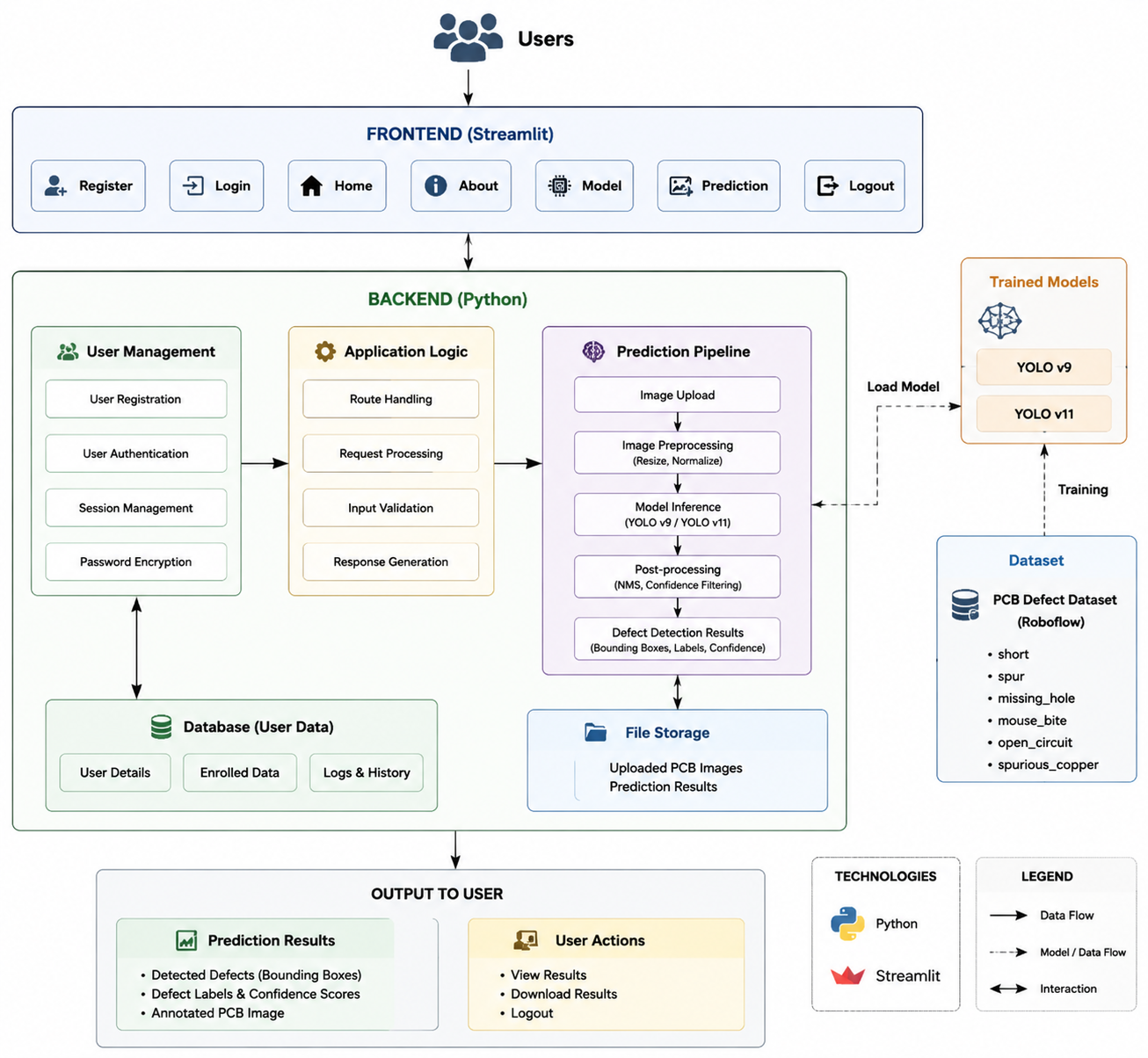
Specifications
4.1 Hardware Requirements
Processor - I3/Intel Processor
Hard Disk - 160GB
Key Board - Standard Windows Keyboard
Mouse - Two or Three Button Mouse
Monitor - SVGA
RAM - 8GB
4.2 Software Requirements:
Operating System : Windows 7/8/10
Server side Script : HTML, CSS, Bootstrap & JS
Programming Language : Python
Libraries : Django, Pandas, NumPy, TensorFlow, Scikit-learn.
IDE/Workbench : VS Code
Technology : Python 3.10
Database : SQLite


 Paper Publishing

Request Call Back
Would you like to receive a free callback now?
Choose the best time for callback:
Leave your message and we will contact you as soon as possible

6-2-85/B, Old Maternity Hospital Road, Thyagaraja Nagar, Tirupati, Andhra Pradesh – 517501
+91 9030333433
+91 9393939065
0877-2261612

Disclaimer - Takeoff Edu Group Projects are not associated or affiliated with IEEE in any way. The IEEE Projects mentioned here are mentioned in the context of student projects, whose ideas are derived from IEEE publications, not projects of or by IEEE.

