Mosquito Species Classification through Wingbeat Analysis: A Hybrid Machine Learning Approach
Objective
The objective of this study is to explore the potential of utilizing wingbeat sound features for the detection and classification of various species of flying mosquitoes using machine learning techniques, specifically a hybrid model combining Convolutional Neural Networks (CNN) and Support Vector Machines (SVM). The aim is to achieve accurate identification and classification of mosquito species, ultimately contributing to the reduction of mosquito-borne disease transmission and related fatalities.
Abstract
Global public health continues to face substantial obstacles from mosquito-borne diseases, making precise and effective techniques for mosquito species identification necessary. We present a unique method in this article called "Mosquito Species Classification through Wingbeat Analysis: A Hybrid Machine Learning Approach," which uses wingbeat analysis and deep learning techniques to classify mosquito species. Our approach leverages Convolutional Neural Networks (CNNs) as the core model to provide robust and dependable classification performance.
We make use of an extensive dataset that includes wingbeat recordings from many species of mosquitoes and apply comprehensive preprocessing and feature engineering techniques to enhance the model's effectiveness. Specifically, we extract and combine features such as zero crossing rate (ZCR), root mean square energy (RMSE), mel-frequency cepstral coefficients (MFCC), as well as augmented features derived from audio transformations like add_noise, shifting, pitching, and stretching. This combination of handcrafted and augmented features helps to enrich the training data and improve the generalizability of the model.
After thorough testing and evaluation, we demonstrate that our CNN-based method achieves superior performance in accurately classifying various mosquito species. Our findings underscore the potential of deep learning methods, particularly CNNs, to surpass conventional classification techniques in species identification tasks. Additionally, we highlight the critical role of accurate species classification in vector surveillance and epidemiological research, emphasizing the broader impact of our work on ecological studies and disease control strategies.
Keywords: Deep learning, CNN, species classification, wingbeat analysis, mosquito-borne diseases, ZCR, RMSE, MFCC, data augmentation.
NOTE: Without the concern of our team, please don't submit to the college. This Abstract varies based on student requirements.
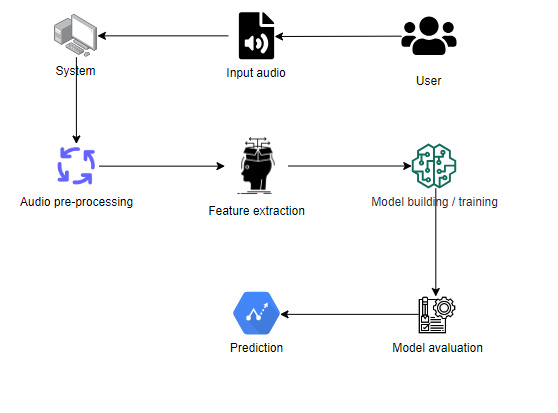
Block Diagram
Specifications
Hardware Requirements
Processor - I3/Intel Processor
Hard Disk - 160GB
Key Board - Standard Windows Keyboard
Mouse - Two or Three Button Mouse
Monitor - SVGA
RAM - 8GB
Software Requirements:
Operating System : Windows 7/8/10/11
Server side Script : HTML, CSS, Bootstrap & JS
Programming Language : Python
Libraries : Flask, Pandas, Mysql.connector, Os, Smtplib, Numpy
IDE/Workbench : PyCharm or VS Code
Technology : Python 3.6+
Server Deployment : Xampp Server
Database : MySQL

Demo Video


Request for Video
 Paper Publishing
Request Call Back
Would you like to receive a free callback now?
Choose the best time for callback:
Leave your message and we will contact you as soon as possible

6-2-85/B, Old Maternity Hospital Road, Thyagaraja Nagar, Tirupati, Andhra Pradesh – 517501
+91 9030333433
+91 9393939065
0877-2261612

Disclaimer - Takeoff Edu Group Projects are not associated or affiliated with IEEE in any way. The IEEE Projects mentioned here are mentioned in the context of student projects, whose ideas are derived from IEEE publications, not projects of or by IEEE.

