Modelling and Controller Design for Temperature Control of Power Plant Heat Exchanger
Objective
The main objective of this project is produce sustain wide range of temperature and pressure.
Abstract
Power Plant Heat exchanger is widely used in
chemical and petroleum plants because it can sustain wide range of temperature
and pressure. Heat exchanger is a high nonlinearity and poor dynamics plant;
therefore it is complex to model and difficult to control its dynamics.
In this paper a Second Order Plus Dead Time (SOPDT model) that is derived from the response of heat exchanger is proposed.
While the controllers are consisted of Fuzzy Proportional Derivative (FPD) controller and Proportional Integral Derivative (PID) controller and applied to the model and their responses are compared with the existing PID controller. For the controller, the FPD control gives a slight enhancement based on SOPDT model. Therefore, FPD controller is more suitable than PID controller.
Keywords Power Plant Heat Exchanger, Modelling, Fuzzy Control, PID Control
NOTE: Without the concern of our team, please don't submit to the college. This Abstract varies based on student requirements.
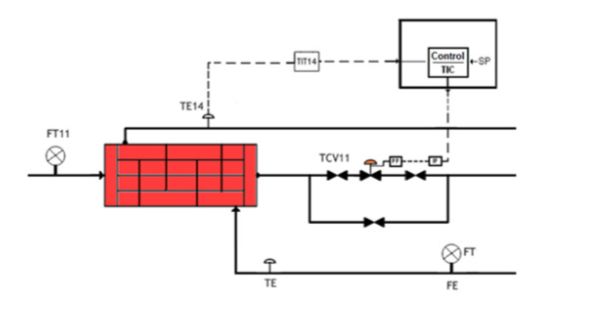
Block Diagram
Specifications
Software Configuration:
Operating System : Windows 7/8/10
Application Software : Matlab/Simulink
Hardware Configuration:
RAM : 8 GB
Processor : I3 / I5(Mostly prefer)
Learning Outcomes
- Introduction to Matlab/Simulink
- What is EISPACK & LINPACK
- How to start with MATLAB
- About Matlab language
- About tools & libraries
- Application of Matlab/Simulink
- About Matlab desktop
- Features of Matlab/Simulink
- Basics on Matlab/Simulink
- Introduction to solar power generation
- Introduction to Matlab/Simulink software
- Introduction to PID controller.
- Introduction to thermal power plant
- Introduction of heat exchanger
- Design of PID controller.
- Introduction to fuzzy logic controller
- Design of fuzzy logic controller
- Project Development Skills:
- Problem analyzing skills
- Problem solving skills
- Creativity and imaginary skills
- Programming skills
- Deployment
- Testing skills
- Debugging skills
- Project presentation skills
- Thesis writing skills
Demo Video


Request for Video
 Paper Publishing
Request Call Back
Would you like to receive a free callback now?
Choose the best time for callback:
Leave your message and we will contact you as soon as possible

6-2-85/B, Old Maternity Hospital Road, Thyagaraja Nagar, Tirupati, Andhra Pradesh – 517501
+91 9030333433
+91 9393939065
0877-2261612

Disclaimer - Takeoff Edu Group Projects are not associated or affiliated with IEEE in any way. The IEEE Projects mentioned here are mentioned in the context of student projects, whose ideas are derived from IEEE publications, not projects of or by IEEE.

