Mobile IoT for Multistage Diabetic Foot Ulcer Detection Using DeepLearning
Objective
The "Mobile IoT for Multistage Diabetic Foot Ulcer Detection Using Deep Learning" project aims to develop a mobile-based IoT system for the early detection and monitoring of diabetic foot ulcers. By leveraging wearable devices such as smart insoles or foot sensors, the system collects real-time data on foot temperature, pressure, and moisture levels. Deep learning models analyze these data to detect early signs of ulcers and classify their stages. The system provides timely alerts to patients and healthcare providers, enabling proactive intervention. This solution improves patient outcomes by preventing complications and reducing the need for invasive treatments.
Abstract
This project presents a web-enabled deep learning system for automated Diabetic Foot Ulcer (DFU) analysis and severity assessment, integrating DenseNet-based attention models and a ShuffleNet Refined Analysis algorithm within a Flask framework. The system is designed to support end-to-end DFU screening, including user authentication, image upload, prediction, confidence estimation, and result storage using a MySQL database. Two complementary deep learning pipelines are employed. First, a DenseNet-169 model enhanced with Channel-wise Cross-Domain Global Spatial (CCDGS) attention is used to perform binary classification of foot images into Normal and Abnormal categories by learning discriminative spatial and channel-level features. Second, a custom ShuffleNet architecture is utilized for refined abnormality analysis, further categorizing abnormal cases into Low, High, and Very High severity stages based on confidence-driven threshold logic. This lightweight ShuffleNet-based refinement enables efficient detection of subtle visual variations across DFU progression stages while maintaining low computational overhead, making it suitable for real-time inference. The models are trained and evaluated on the publicly available Kaggle DFU dataset, achieving classification accuracies exceeding 95%. A Flask-based web application, integrated with HTML, CSS, and JavaScript, allows users to register, log in, upload foot images, and receive instant predictions with confidence scores, while securely maintaining prediction history. The proposed system offers a scalable, accessible, and cost-effective solution for remote DFU screening and severity assessment, supporting early intervention and improved diabetic foot care through intelligent healthcare automation.
Keywords: Diabetic Foot Ulcer (DFU), ShuffleNet Refined Analysis, DenseNet-169, CCDGS Attention, Severity Classification, Flask Web Application, Medical Image Analysis, Deep Learning, Abnormality Staging, Healthcare AI, Remote Diagnosis.
NOTE: Without the concern of our team, please don't submit to the college. This Abstract varies based on student requirements.
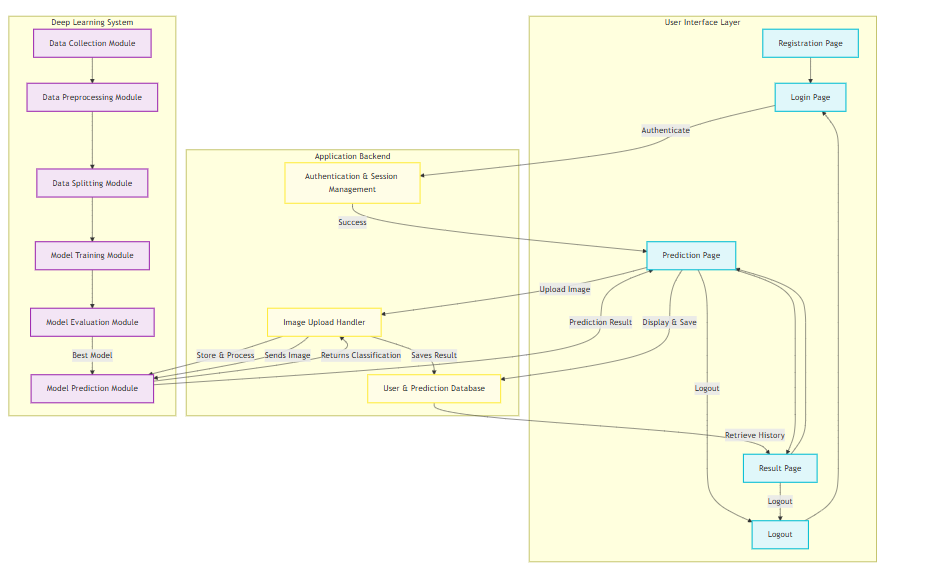
Block Diagram
Specifications
SOFTWARE REQUIREMENS
Operating System : Windows 7/8/10
Server-side Script : HTML, CSS, Bootstrap & JS
Programming Language : Python
Libraries : Flask, Pandas, , Sklearn,Pytorch NumPy, Seaborn, Matplotlib
IDE/Workbench : VSCode
Technology : Python 3.8+
Server Deployment : Xampp Server
Database : MySQL
HARDWARE REQUIREMENTS
Processor - I5/Intel Processor
RAM - 8GB +(min)
Hard Disk - 128 +GB
Key Board - Standard Windows Keyboard
Mouse - Two or Three Button Mouse
Monitor - Any


 Paper Publishing

Request Call Back
Would you like to receive a free callback now?
Choose the best time for callback:
Leave your message and we will contact you as soon as possible

6-2-85/B, Old Maternity Hospital Road, Thyagaraja Nagar, Tirupati, Andhra Pradesh – 517501
+91 9030333433
+91 9393939065
0877-2261612

Disclaimer - Takeoff Edu Group Projects are not associated or affiliated with IEEE in any way. The IEEE Projects mentioned here are mentioned in the context of student projects, whose ideas are derived from IEEE publications, not projects of or by IEEE.

