Maximum Power Point Tracking Injection Method for Islanding Detection of Grid-Connected Photovoltaic Systems in Microgrid
Objective
The main objective of this project is to maintain the stability of the system, improve the power quality and Quick power restoration to MPP.
Abstract
In this project, a novel Islanding Detection Method (IDM) for Grid-Connected Photo Voltaic Systems (GCPVSs) through a disturbance injection in the Maximum Power Point Tracking (MPPT) algorithm is proposed. When an absolute deviation of the output voltage exceeds a threshold, the applied disturbance shifts system operating point from its Maximum Power Point (MPP) condition. This leads to a sharp active power output reduction and consequently, a significant voltage drops in islanded mode beyond the standard voltage limit.
The proposed algorithm is defined in a way that the Distributed Generator (DG) can be restored to MPP after islanding classification. It is thereby effective in micro grid in where the power injection at maximum level to cater the critical loads and maintain the stability of the isolated area are pursued. An intentional time delay has also been considered to avoid nuisance tripping in short-circuit faults which do not require tripping.
The provided results under extensive islanding scenarios defined in islanding standards endorse timely and accurately detection with negligible Non-Detection Zone (NDZ) as well as no false tripping in non-islanding disturbances. The comparative analysis of the presented scheme with a few recent IDMs for GCPVS highlights its overall superiorities, including very small NDZ, fast detection, thresholds self-standing determination, no adverse effect on power quality, and simple and inexpensive integration.
Keywords: Grid-Connected Photo Voltaic Systems (GCPVSs), Islanding Detection Method (IDM), Maximum Power Point Tracking (MPPT), Distributed Generator (DG), Power Electronic Converters.NOTE: Without the concern of our team, please don't submit to the college. This Abstract varies based on student requirements.
Block Diagram
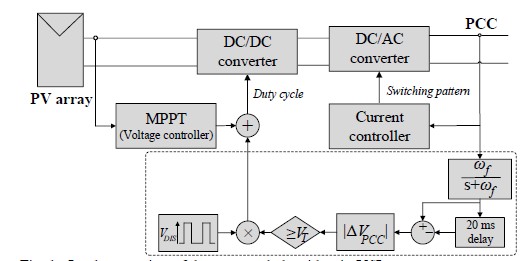
Specifications
Software Configuration:
Operating System : Windows 7/8/10
Application Software : Matlab/Simulink
Hardware Configuration:
RAM : 8 GB / 4 GB (Min)
Processor : I3 / I5(Mostly prefer)
Learning Outcomes
- Introduction to Matlab/Simulink
- What is EISPACK & LINPACK
- How to start with MATLAB
- About Matlab language
- About tools & libraries
- Application of Matlab/Simulink
- About Matlab desktop
- Features of Matlab/Simulink
- Basics on Matlab/Simulink
- Introduction to solar power generation.
- Introduction to Matlab/Simulink software.
- Introduction to power electronics converters.
- Introduction to phase locked loop (PLL).
- Introduction to PWM techniques.
- Introduction to DC/DC Converter.
- Introduction to DC/AC Converter.
- Introduction to Current Controller.
- Introduction to Distribution Generators.
- Introduction to Transformers.
- Introduction to filters.
- Introduction to Synchronous Generator.
- Design of PLL.
- Design of solar PV system.
- Design of MPPT controller.
- Design of DC – DC boost converter.
- Design of bidirectional DC -DC converter.
- Design of Voltage source converter.
- We can learn about the generation of gate pulses to the converter.
- Introduction to controllers.
- Design of PI controller.
- Project Development Skills:
- Problem analyzing skills
- Problem solving skills
- Creativity and imaginary skills
- Programming skills
- Deployment
- Testing skills
- Debugging skills
- Project presentation skills
- Thesis writing skills


 Paper Publishing

Request Call Back
Would you like to receive a free callback now?
Choose the best time for callback:
Leave your message and we will contact you as soon as possible

6-2-85/B, Old Maternity Hospital Road, Thyagaraja Nagar, Tirupati, Andhra Pradesh – 517501
+91 9030333433
+91 9393939065
0877-2261612

Disclaimer - Takeoff Edu Group Projects are not associated or affiliated with IEEE in any way. The IEEE Projects mentioned here are mentioned in the context of student projects, whose ideas are derived from IEEE publications, not projects of or by IEEE.

