Machine Learning Perspective Fraud Payment Transaction Detection
Objective
The project aims to detect fraudulent payment transactions using machine learning techniques. The dataset used is the Banksim1 dataset from Kaggle, containing simulated banking transactions. Current models such as GMB, random forests, decision trees, and logistic regression will serve as benchmarks. The proposed models for this project include HistGradientBoosting, CatBoost, KNN, LGBM, and logistic regression. These algorithms will be evaluated based on their accuracy and efficiency in identifying fraudulent transactions. The goal is to determine which model provides the most reliable and scalable solution for fraud detection.
Abstract
Fraud detection in financial transactions is crucial for securing payment systems and preventing illegal activities. This project focuses on utilizing machine learning algorithms to develop a fraud detection system for payment transactions. The dataset used is the "Banksim1" dataset from Kaggle, which simulates banking transactions with both legitimate and fraudulent activities. To detect fraudulent transactions, several machine learning algorithms were implemented and evaluated, including K-Nearest Neighbors (KNN), Logistic Regression, CatBoost, HistGradientBoosting, and LightGBM. The models were trained on the dataset and tested for accuracy in identifying fraudulent transactions based on features such as transaction amount, customer ID, and transaction type. The system was built using Python with Flask for the backend and HTML, CSS, and JavaScript for the frontend, allowing users to interact with the fraud detection model. The results show that the machine learning-based approach significantly outperforms traditional rule-based systems, offering high accuracy and efficiency in fraud detection. The CatBoost model demonstrated the best performance in terms of accuracy and speed, while the HistGradientBoosting model showed a strong balance between precision and recall. The project concludes that machine learning models, when applied to payment transaction data, can enhance the detection and prevention of fraudulent activities in payment systems. Future work could involve improving model performance and implementing real-time transaction monitoring.
Keywords:
Fraud detection, machine learning, KNN, Logistic Regression, CatBoost,
HistGradientBoosting, LightGBM, payment transactions, dataset, Flask.
NOTE: Without the concern of our team, please don't submit to the college. This Abstract varies based on student requirements.
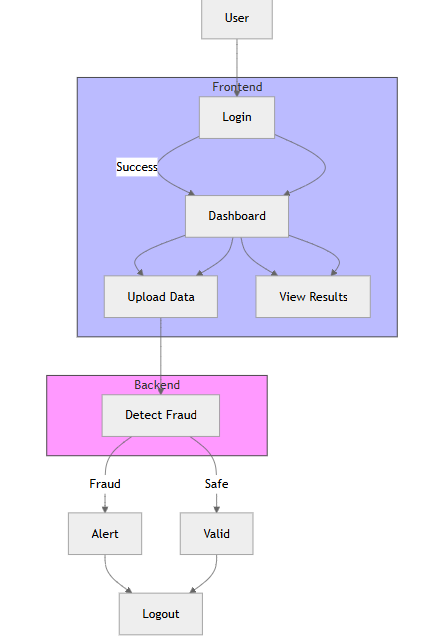
Block Diagram
Specifications
H/W CONFIGURATION:
To ensure optimal performance and scalability of the fraud detection system, the following hardware configuration is recommended:
1. Server:
o Processor: Multi-core processor (Intel Xeon or AMD Ryzen 7 and above) for efficient parallel processing and model inference.
o RAM: Minimum of 16 GB of RAM, with 32 GB recommended for handling large datasets and simultaneous user requests.
o Storage: SSD storage with at least 500 GB for faster data access and efficient model saving/loading.
o GPU (optional): For deep learning or high-performance models (if used), a GPU like NVIDIA Tesla or GTX series would significantly accelerate training and inference times.
2. Database Server:
o Processor: Multi-core processor for handling high transaction loads.
o RAM: Minimum 16 GB for smooth database operations.
o Storage: 500 GB+ SSD for faster database querying and efficient transaction record storage.
3. Network:
o Bandwidth: High-speed internet connection (at least 1 Gbps) to handle large data uploads and multiple simultaneous user interactions without delays.
o Firewall/Security: Hardware firewall and load balancing for ensuring security and high availability.
4. Backup and Redundancy:
o Backup Server: Separate backup systems with redundant storage for data protection and system resilience.
S/W CONFIGURATION:
To ensure smooth operation and efficient performance of the fraud detection system, the following software configuration is recommended:
- Operating System:
- Linux (Ubuntu, CentOS, or Debian) for better performance, security, and compatibility with machine learning libraries.
- Windows Server (for users who prefer Windows environments, though Linux is often preferred for machine learning applications).
- Web Framework:
- Flask (Python): A lightweight web framework for building the backend, handling routes, and serving machine learning models.
- Gunicorn (or other WSGI servers): Used for running Flask in a production environment to handle multiple requests concurrently.
- Frontend Technologies:
- HTML5: For structuring the web pages.
- CSS3: For styling the web pages, ensuring responsiveness.
- JavaScript: For client-side interactivity.
- Bootstrap: A front-end framework for responsive design, ensuring the application works on both desktop and mobile devices.
- Database Management System (DBMS):
- MySQL or SQLite: For storing user data, transaction records, and results of fraud detection.
- SQLAlchemy: ORM (Object Relational Mapper) for interacting with MySQL/SQLite databases through Python.
- Machine Learning Libraries:
- Scikit-learn: For implementing algorithms like KNN, Logistic Regression, and other classical models.
- CatBoost, LightGBM, HistGradientBoosting, XGBoost: For gradient boosting algorithms for fraud detection.
- Pandas: For data manipulation and analysis.
- NumPy: For numerical operations.
- Joblib: For model serialization and deployment.
- TensorFlow or PyTorch (optional): For implementing deep learning models (if used in the future).
- Version Control:
- Git: For source code management and collaboration.
- GitHub or GitLab: For hosting the code repository and version control.
- Security:
- SSL/TLS: For secure data transmission (HTTPS).
- OAuth2 or JWT (JSON Web Tokens): For secure user authentication and session management.
- Containerization:
- Docker: To containerize the application, making it easier to deploy and scale in different environments (e.g., cloud or on-premises).
- Kubernetes (optional): For managing containers at scale, ensuring high availability and scalability.
- Analytics and Monitoring:
- Prometheus and Grafana: For monitoring the system's performance, transaction volume, and detecting potential bottlenecks.
- Elasticsearch: For log management and analysis, helping in debugging and tracking the system's health.


 Paper Publishing

Request Call Back
Would you like to receive a free callback now?
Choose the best time for callback:
Leave your message and we will contact you as soon as possible

6-2-85/B, Old Maternity Hospital Road, Thyagaraja Nagar, Tirupati, Andhra Pradesh – 517501
+91 9030333433
+91 9393939065
0877-2261612

Disclaimer - Takeoff Edu Group Projects are not associated or affiliated with IEEE in any way. The IEEE Projects mentioned here are mentioned in the context of student projects, whose ideas are derived from IEEE publications, not projects of or by IEEE.

